Ägäis
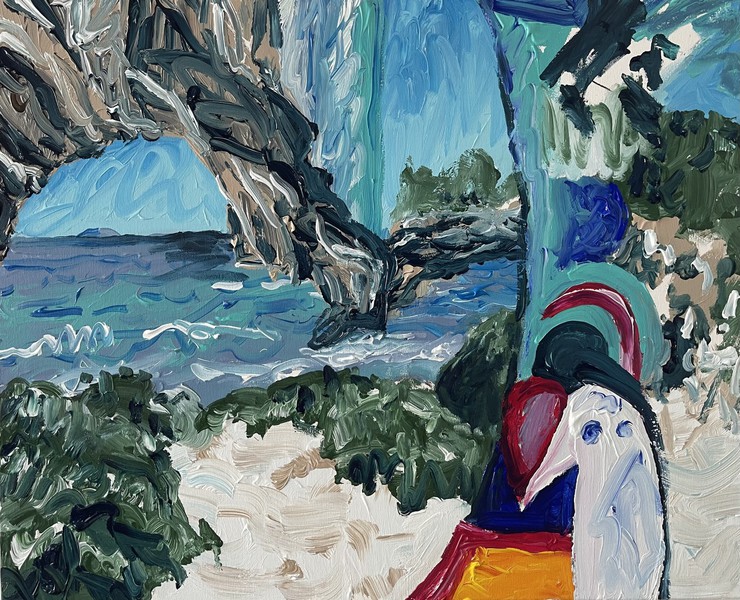
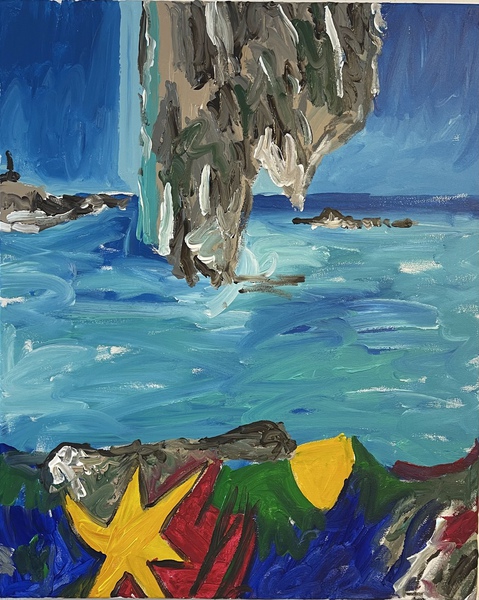
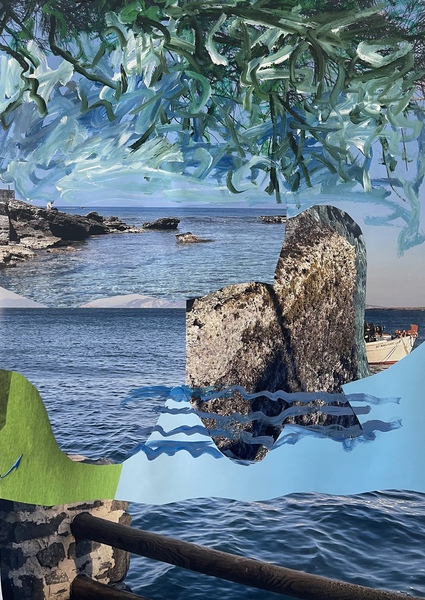
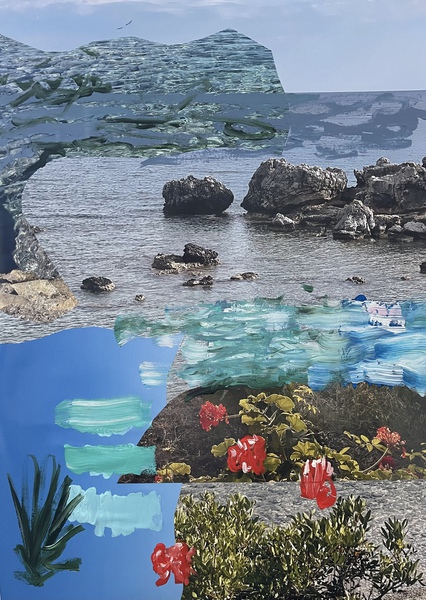
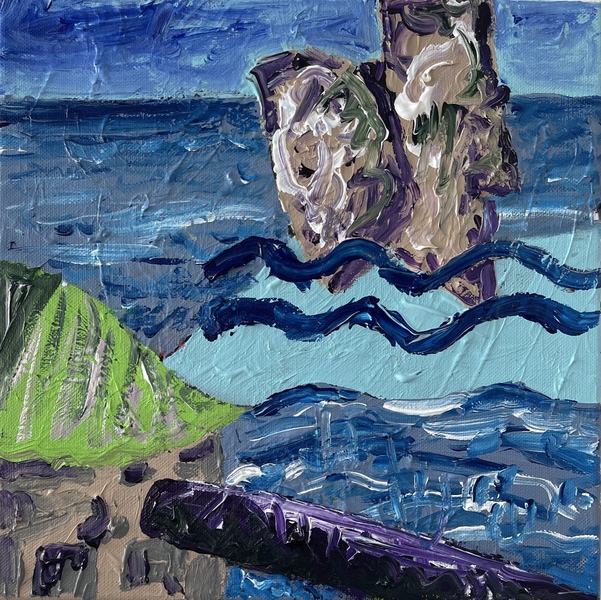
Diese Gemälde- und Collage-Serie kreist um die Ägäis – jedoch nicht als geografisch exakt beschreibbaren Ort, sondern als kulturellen, imaginären und malerischen Raum. Das Meer erscheint hier als eine Bildfläche, auf der sich Wahrnehmung, Erinnerung, Landschaft und Malerei miteinander verschränken. Die Ägäis wird zum Übergangsraum zwischen Natur und Kultur, zwischen unmittelbarer Anschauung und künstlerischer Transformation.
Die Arbeiten verbinden meine eigenen Fotos von Küsten, Felsen, Wasserflächen und Vegetation mit malerischen Überarbeitungen. Dadurch entsteht ein Spannungsverhältnis zwischen dokumentarischem Blick und subjektiver Bildfindung. Die Fotografie scheint zunächst einen konkreten Ort festzuhalten, doch die darübergelegten Pinselspuren lösen diese Eindeutigkeit wieder auf. Die Landschaft wird nicht abgebildet, sondern neu erfahren. Sie erscheint als etwas Prozessuales, als ständige Verwandlung zwischen Sehen und Erinnern.
Dabei knüpfen die Arbeiten an eine lange Tradition mediterraner Landschaftsbilder an. Seit der Antike gilt die Ägäis als Ursprungsraum europäischer Mythen, Philosophien und ästhetischer Vorstellungen. Doch anstelle einer idealisierten Arkadien-Sehnsucht zeigen diese Bilder eine Gegenwart der Fragmente. Die Küsten, Horizonte und Inselformen werden nicht als harmonische Ganzheiten präsentiert, sondern als Bildsplitter, die sich zu immer neuen Konstellationen verbinden. Die Landschaft wird zum „Remix“ ihrer eigenen kulturellen Überlieferungen.
Die malerischen Spuren wirken wie Zeichen eines Sehens, das die Wiedergabe der Welt betont, aber auch die Bedingungen des Sehens selbst reflektiert.
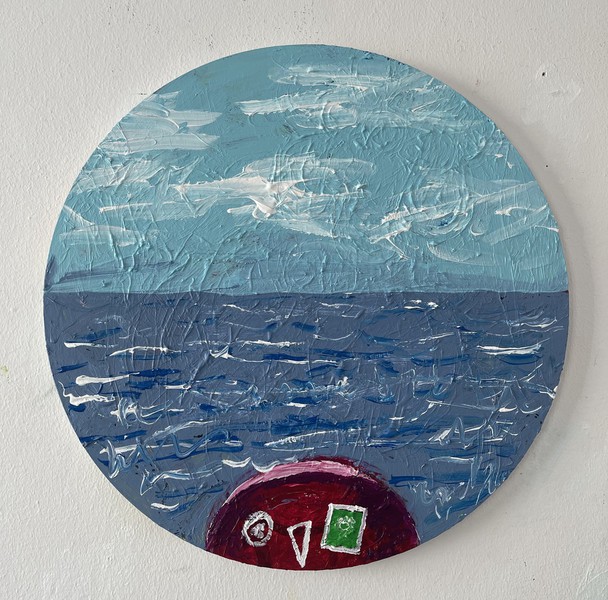
Das runde Gemälde ("Ägäis 03") mit seiner strengen Horizontteilung wirkt wie die Aussicht durch das Bullauge eines Schiffes: Himmel und Meer erscheinen als elementare Farbzonen, während die kleinen Zeichen am unteren Rand wie Erinnerungsreste oder archaische Symbole auftauchen.
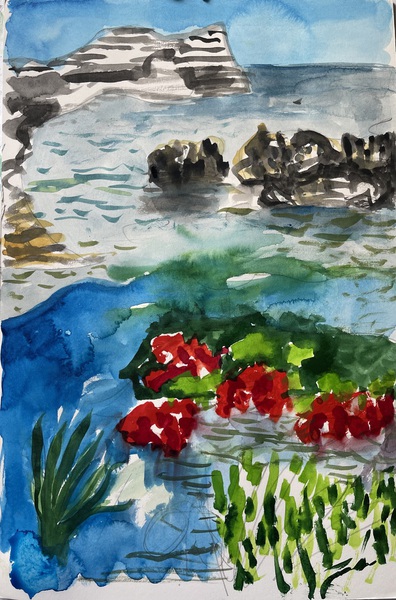
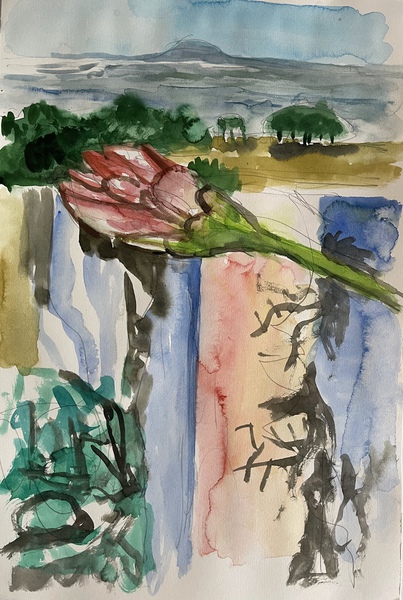
This series of paintings and collages revolves around the Aegean Sea—not as a geographically definable location, but as a cultural, imaginary, and painterly space. Here, the sea appears as a pictorial surface on which perception, memory, landscape, and painting intertwine. The Aegean Sea becomes a transitional space between nature and culture, between direct observation and artistic transformation.
The works combine my own photographs of coastlines, rocks, bodies of water, and vegetation with painterly reworkings. This creates a tension between a documentary perspective and subjective image-making. At first glance, the photograph appears to capture a specific place, yet the brushstrokes superimposed upon it dissolve this clarity. The landscape is not merely depicted but re-experienced. It emerges as a process, a constant transformation between seeing and remembering.
In doing so, the works draw on a long tradition of Mediterranean landscape imagery. Since antiquity, the Aegean has been regarded as the birthplace of European myths, philosophies, and aesthetic concepts. Yet instead of an idealized longing for Arcadia, these images reveal a present made up of fragments. The coasts, horizons, and island shapes are not presented as harmonious wholes, but as fragments of images that combine into ever-changing constellations. The landscape becomes a “remix” of its own cultural traditions.
The painterly traces appear as signs of a vision that emphasizes the representation of the world, but also reflects on the conditions of seeing themselves.
The round painting (“Aegean 03”), with its stark division of the horizon, resembles the view through a ship’s porthole: sky and sea appear as elemental zones of color, while the small marks at the bottom emerge like fragments of memory or archaic symbols.
 Druckversion