Verklärungen
Mit seinem Erstlingswerk „Die Geburt der Tragödie aus dem Geist der Musik“ provozierte und verstörte 1872 der 27jährige Basler Professor Friedrich Nietzsche die damalige Philologie wie auch die Philosophie. Dort erweitert er den Deutungs-Rahmen von Raffaels „Transfiguration“ (Verklärung), indem er dessen religiöse Thematik unter dem Begriffspaar des Dionysisch-Apollinischen interpretiert.
Die "Verklärung", die bis zum Beginn des 20. Jahrhunderts als das berühmteste Gemälde der Welt galt, wurde 1516 für die Kathedrale von Narbonne in Auftrag gegeben und war 1520 beim Tode Raffaels bis auf wenige Stellen fertig. Es sollte dort aber nie ankommen, da der Auftraggeber, Giulio di Medici, inzwischen Papst geworden war und es in Rom in einer Kirche aufstellen ließ. Heute befindet es sich in den Vatikanischen Museen in Rom.
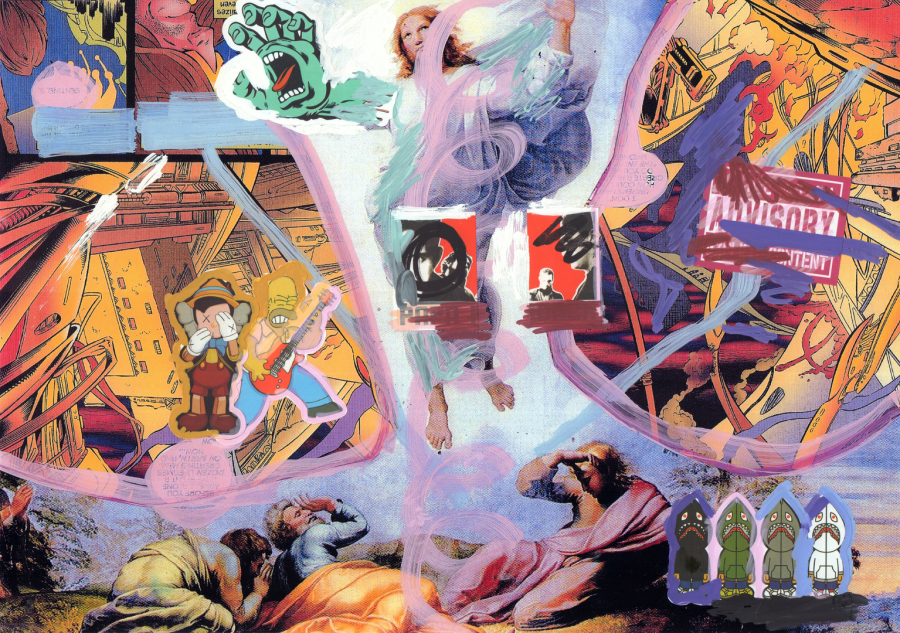 Verklärung 03, 2020, Fine Art Print, 60 x 80 cm
Transfiguratio ist die lateinische Übersetzung des griechischen metamorphosis („Verwandlung“) und hat im Christentum die Bedeutung der „Verklärung“ Christi angenommen.
Das Bildgeschehen der „Transfiguration“ kann man in drei Teile zerlegen: die untere Hälfte mit dem epileptischen Knaben, die mittlere mit den drei vom göttlichen Licht geblendeten Aposteln und die obere mit der „visionsgleichen ambrosianischen Scheinwelt“ (Nietzsche). Nach dem Evangelisten Matthäus führte Christus drei seiner Jünger auf den Berg Tabor, wo er von einem überirdischen Licht „verklärt“ wurde: „Sein Antlitz strahlte wie die Sonne und seine Kleider wurden weiß wie das Licht.“ Diese lichtumflossenen Verklärung Christi, das „Taborlicht" inspirierte viele christliche Mystikerinnen und Mystiker.
.Raffael verbindet in der „Transfiguration“ die Verklärung Christi mit einer anderen biblischen Szene, der Wunderheilung eines epileptischen Knaben.
Licht
Nietzsche nennt die untere Hälfte des Gemäldes, die Welt von Verzweiflung, Angst und Schmerz, „Schein“, da durch die künstlerische Figuration der eigentlich nicht darstellbare „ewige Urschmerz“ in Erscheinung tritt, der dazu als „den ewigen Widerspruch, des Vaters der Dinge“, jene obere apollinische Scheinwelt der erlösenden Verklärung braucht, ohne die er gar nicht erscheinen könnte. Als dritten Schein gibt es eine Zwischenwelt, die von den drei hingestreckten Aposteln gebildet wird, die einerseits die Vision des verklärten Christus haben und andererseits dadurch die untere Welt der Verzweiflung als Schein entlarven. Mittels der „Depotenzierung des Scheins zum Schein“ (Nietzsche) wird in Raffaels Werk die „schmerzhafte Urwirklichkeit“ zum realen Schein der Kunst verklärt.
Die beiden schwebenden Figuren neben Christus sind rechts Moses mit den Gesetzestafeln und links der Prophet Elias. Moses empfängt bekanntlich die Zehn Gebote auf dem Berg Sinai von Gott, der in einem auf dem Berg Horeb sich Elias durch seine Stimme zu erkennen gibt.
"Die Verklärung durch das Licht bewirkt „mit einer unwiderstehlichen, transzendenten Potenz die Ablösung des Sinnlichen im herrlichen Glanze dessen, was Platon das Intelligible nennt: oder vielmehr…nimmt letztlich die Trans-Figuration das Fleisch der Welt, der Dinge des Seins im Licht des BILDES auf sich.“ schreibt Louis Marin. Er bezeichnet weiterhin Raffaels „Transfiguration“ als „die Vision des Licht-Bildes“ auf der Leinwand und konstatiert, „dass dieses Antlitz, dieser Körper, diese Kleider Lichtwolke geworden sind, deren spürbare fleischliche Dichte in eine sich ausbreitende Wolke zerstäubt ist, wo das LICHT, die LICHT-FIGUR, das BILD opak geworden ist, zur Opazität der Wolke, ohne seine Lichttransparenz zu verlieren.“ (Louis Marin)
Marin konstruiert dergestalt eine "Licht-Stimme“, die Bild geworden ist - analog dem Vers 14 des Johannes-Evangeliums: „Und das Wort ist Fleisch geworden und hat unter uns gewohnt und wir haben seine Herrlichkeit gesehen, die Herrlichkeit des einzigen Sohnes vom Vater, voll Gnade und Wahrheit.“ Als Fazit stellt Marin fest, dass die „Verklärung“ es erlaube, diese Äquivalenz der Stimme und des Lichts zu sehen und zu hören, ohne dass es möglich wäre, die Verklärung selbst anzuschauen und zu vernehmen. Damit wird das Sichtbare auf dem Gemälde Raffaels zu einem Quid pro quo, zu einem Substitut des Unsichtbaren, wobei das eine ins andere umschlägt und vice versa. In diesem Sinne ist Goethes Feststellung der gegenseitigen Einwirkung von Unten, des „Leidenden, Bedürftigen“ und von Oben, des „Hilfreichen und Wirksamen“ der raffaelschen Szenerie zu verstehen, die Goethe neben den Fresken des Campo Santo in Pisa zur Apotheose Fausts am Schluss von Faust II angeregt hat:
(Bergschluchten, Wald, Fels, Einöde
Heilige Anachoreten
Pater ecstaticus auf und abschweifend):
"Ewiger Wonnebrand,
Glühendes Liebeband,
Siedender Schmerz der Brust,
Schäumende Gottes-Lust
Pfeile durchdringet mich,
Lanzen bezwinget mich
Keulen zerschmettert mich,
Blitze durchwettert mich."
Raffael galt schon zu Lebzeiten als Künstler, dessen Schöpfertum parallel zur Natur und damit fast als gottgleich angesehen wurde. So lautet die Inschrift auf seinem Grab im Pantheon in Rom:
"Hier ruht Raffael, von dem die Mutter aller Dinge (die Natur) zu seinen Lebzeiten fürchtete, übertroffen zu werden, und um den sie nun, wo er tot ist, trauert."
Weisheit des Silen
Friedrich Nietzsche erscheint Raffaels „Verklärung“ Nietzsche in einem neuen profanisierten Licht:
„In Raffaels Transfiguration zeigt uns die untere Hälfte, mit dem besessenen Knaben, den verzweifelnden Trägern, den ratlos geängstigten Jüngern, die Wiederspiegelung des ewigen Urschmerzes, des einzigen Grundes der Welt: der „Schein“ ist hier Widerschein des ewigen Widerspruchs, des Vaters der Dinge. Aus diesem Schein steigt nun, wie ein ambrosischer Duft, eine visionsgleiche neue Scheinwelt empor, von der jene im ersten Schein Befangenen nichts sehen – ein leuchtendes Schweben in reinster Wonne und schmerzlosem, aus weiten Augen strahlenden Anschauen. Hier haben wir in höchster Kunstsymbolik jene apollinische Schönheitswelt und ihren Untergrund, die schreckliche Weisheit des Silens vor unseren Blicken und begreifen, durch Intuition, ihre gegenseitige Notwendigkeit.“
Die „Weisheit des Silens“ ist für Nietzsche jener Ausspruch des Silen, dass es das Allerbeste für die Menschen, jenes „Eintagsgeschlecht, des Zufalls Kinder und der Mühsal“ wäre, „nicht geboren zu sein, nicht zu sein, nichts zu sein“. Silen hat seit der antiken Kunst eine wenig schmeichelhafte Performance als betrunkener, fettleibiger Alter hingelegt, dem man seine andere Seite als Weisheitsvermittler und als Erzieher des kleinen Dionysos nicht mehr ansieht. Er entstammt dem alten Reich der Naturdämonen, wie die Schar der Satyrn mit ihrem Gott Pan.
Da der christlich inspirierte Neoplatonismus den platonischen Demiurgen als Weltschöpfer und letzte Ursache mit dem christlichen Schöpfergott identifizierte, konnte die Natur als „Mutter aller Dinge“ mit der christlichen Trinität „Vater-Sohn-Geist“ interpretiert werden. Die Idee vom Künstler als gottgleichem Schöpfer geht auf die Überlagerung der Vorstellung des christlichen Schöpfergotts mit der aristotelischen Idee einer Teleologie des Stoffs zurück. Im Stoff sei das spätere Kunstwerk, laut Aristoteles, schon als Idee präfiguriert, was der Künstler-Handwerker zu entbergen habe.
Diese uns fremde antike metaphysische Vorstellung beinhaltet nichts weniger als die Überzeugung, dass die produktive Aktivität im Kunstwerk wohnt und nicht im Künstler, der es gemacht hat.
In einem langen, Jahrhunderte dauernden Prozess entwickelte das frühe Christentum in der Auseinandersetzung zwischen Ikonoklasten und Ikonodulen (Bilderfeinden und Bilderfreunden) die Konzeption eines Kunstwerks, das um den Begriff der Inkarnation zentriert ist. So sollte die Fleischwerdung Christi in der „Fleischwerdung“ des Bildwerks, d. h. in der entsprechenden malerischen bzw. plastischen Gestaltung des Werks repräsentiert sein. Dabei durfte weder die archaische Bildmagie des heidnischen „Götzenbildes“ entstehen, nach dem das Bild nicht nur den Gott repräsentierte, sondern in gewisser Weise dieser selbst war – noch sollte ein bloßes Phantasma, ein täuschendes Trugbild, geschaffen werden. Ohne diese künstlerische Transformation der christlichen Inkarnation ab dem späten Mittelalter ist der abendländische Bildbegriff bis zur Moderne nicht zu denken.
Wenn wir schon seit langem „den Himmel den Engeln und den Spatzen überlassen“, wie Heinrich Heine in seinem „Deutschland, ein Wintermärchen“ dichtete und uns mit mehr oder weniger Erfolg daran gemacht haben, die irdische Welt nicht nur zu verbessern, sondern sie möglichst in ein Irdisches Paradies zu verwandeln, so kommen uns doch in diesem Bemühen immer mehr globale Übel in die Quere, wie Pandemien, Klimawandel, Krisenherde, Wettrüsten, Kriege und andere Katastrophen.
Nietzsche, der Verfasser des „Antichrist“, konnte an der theologischen Lichtmetaphysik des päpstlichen Auftraggebers Raffaels wenig Gefallen finden. So moniert er das „heuchlerische“ Christentum, das man Raffael zuwies. „Das Christentum verdirbt zuletzt gar noch den Begriff des Künstlers: es hat eine schüchterne Hypocrisie (Heuchelei) über Raffael gegossen, zuletzt ist auch sein verklärter Christus ein flatterndes schwärmerisches Mönchlein, das es nicht wagt, sich nackt zu zeigen.“
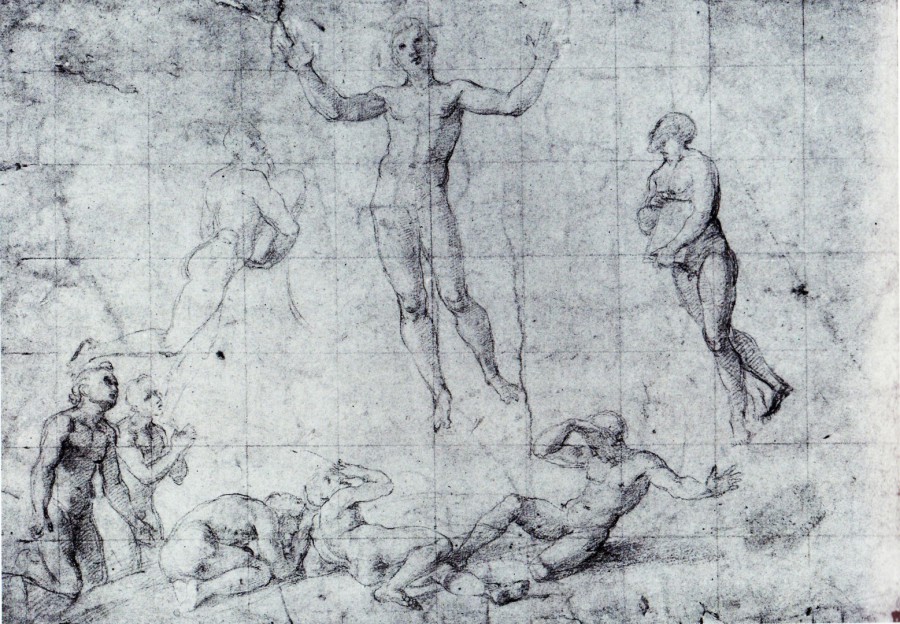 Raffael-Zeichnung
Neue Transfiguration
Vermutlich kannte Nietzsche nicht jene Studie Raffaels zur Transfiguration, die an Stelle von Christus just eine nackte „apollinische“ Jünglingsfigur zeigt, entsprechend Raffaels Verfahren, in den Entwurfszeichnungen zu seinen Kompositionen die Gestalten erst einmal nackt zu zeichnen, um sie dann in seinen Gemälden mit Pinsel und Farbe „anzuziehen“
Für Nietzsche bildet die profanierte Transfiguration Raffaels ein Gegenbild zu der für ihn als negativ empfundenen Passion Christi. So hat er in der „Morgenröthe“, die 1881, knapp 10 Jahre nach der „Geburt der Tragödie“ erschien, eine „neue Transfiguration“ eingefordert: „Die rathlos Leidenden, die verworren Träumenden, die überirdisch Entzückten, – dies sind die Grade, in welche Raffael die Menschen eintheilt. So blicken wir nicht mehr in die Welt – und auch Raffael dürfte es jetzt nicht mehr: er würde eine neue Transfiguration mit Augen sehen.“
Für Nietzsche ist die Kunst das einzige Mittel, die Schrecklichkeiten und Entsetzlichkeiten des Daseins zu ertragen, eben durch deren Kraft und Fähigkeit der Verzauberung und Verklärung. Diese "ästhetische Theodizee "– „nur als ästhetisches Phänomen ist das Dasein und die Welt ewig gerechtfertigt" – ist für Nietzsche die einzige Möglichkeit, die tragisch-dionysische Welt zu überwinden und das Leben überhaupt zu ermöglichen.
Das eingangs gestellte Zitat „Singe mir ein neues Lied: die Welt ist verklärt und alle Himmel freuen sich.“ gehört zu den letzten schriftlichen Äußerungen Nietzsches vor seinem Zusammenbruch und seiner geistigen Umnachtung. Sie waren in Briefform an langjährige Freunde adressiert. Nietzsches Signatur „Der Gekreuzigte“ wechselt in diesen letzten Briefen mit „Dionysos“ ab und verweist einerseits auf die Ähnlichkeit von Dionysos und Christus, andererseits auf das parodistische Spiel Nietzsches mit Identitäten, das selbst in seinen letzten Zeugnissen betreibt.
Transfigurations
With his debut work, *The Birth of Tragedy from the Spirit of Music*, the 27-year-old Basel professor Friedrich Nietzsche provoked and unsettled both philology and philosophy in 1872. In it, he expands the interpretive framework of Raphael’s *Transfiguration* by interpreting its religious theme through the Dionysian-Apollonian dichotomy.
The “Transfiguration”, which was considered the most famous painting in the world until the beginning of the 20th century, was commissioned in 1516 for the Cathedral of Narbonne and was nearly complete by 1520, the year of Raphael’s death. However, it was never destined to arrive there, as the patron, Giulio di Medici, had since become Pope and had it installed in a church in Rome. Today it is located in the Vatican Museums in Rome.
Transfiguratio is the Latin translation of the Greek metamorphosis (“transformation”) and has taken on the meaning of the “Transfiguration” of Christ in Christianity.
The pictorial narrative of the “Transfiguration” can be divided into three parts: the lower half with the epileptic boy, the middle with the three apostles blinded by the divine light, and the upper half with the “vision-like Ambrosian world of illusion” (Nietzsche). According to the Evangelist Matthew, Christ led three of his disciples up Mount Tabor, where he was “transfigured” by a supernatural light: “His face shone like the sun, and his clothes became white as light.” This light-bathed Transfiguration of Christ, the “Tabor light,” inspired many Christian mystics.
In the “Transfiguration,” Raphael combines the Transfiguration of Christ with another biblical scene, the miraculous healing of an epileptic boy.
Light
Nietzsche calls the lower half of the painting—the world of despair, fear, and pain—“appearance,” since through artistic figuration the “eternal primal pain,” which is actually unrepresentable, comes into view; this pain, as “the eternal contradiction, the father of things,” requires that upper Apollonian world of appearance—the redeeming Transfiguration—without which it could not appear at all. As a third appearance, there is an intermediate world formed by the three prostrate apostles, who on the one hand have the vision of the transfigured Christ and on the other hand thereby expose the lower world of despair as an appearance. Through the “depotentiation of appearance into appearance” (Nietzsche), the “painful primordial reality” is transfigured in Raphael’s work into the real appearance of art.
The two floating figures beside Christ are Moses with the tablets of the law on the right and the prophet Elijah on the left. As is well known, Moses receives the Ten Commandments on Mount Sinai from God, who reveals himself to Elijah through his voice on Mount Horeb.
“The transfiguration through light brings about, ‘with an irresistible, transcendent power, the detachment of the sensual in the glorious radiance of what Plato calls the intelligible: or rather… ultimately, the transfiguration takes upon itself the flesh of the world, the things of being, in the light of the IMAGE,’” writes Louis Marin. He further describes Raphael’s “Transfiguration” as “the vision of the image of light” on the canvas and states, “that this face, this body, these garments have become a cloud of light, whose palpable carnal density has atomized into a spreading cloud, where the LIGHT, the FIGURE OF LIGHT, the IMAGE has become opaque, into the opacity of the cloud, without losing its luminous transparency.” (Louis Marin)
In this way, Marin constructs a “voice of light” that has become an image—analogous to verse 14 of the Gospel of John: “And the Word became flesh and dwelt among us, and we beheld His glory, the glory as of the only begotten of the Father, full of grace and truth.” In conclusion, Marin notes that the “Transfiguration” allows one to see and hear this equivalence of voice and light, without it being possible to look upon and hear the Transfiguration itself. Thus, the visible in Raphael’s painting becomes a quid pro quo, a substitute for the invisible, whereby one transforms into the other and vice versa. In this sense, Goethe’s observation of the mutual interaction between below—the “suffering, needy”—and above—the “helpful and effective”—is to be understood in relation to Raphael’s scene, which inspired Goethe, alongside the frescoes of the Campo Santo in Pisa, to create Faust’s apotheosis at the end of Faust II:
(Mountain gorges, forest, rock, wasteland
Holy anchorites
Father ecstaticus, rising and wandering):
“Eternal blaze of bliss,
Glowing bond of love,
Boiling pain of the breast,
Foaming divine delight
Arrows pierce me,
Lances subdue me
Clubs shatter me,
Lightning bolts pierce me.”
Even during his lifetime, Raphael was regarded as an artist whose creativity was seen as parallel to nature and thus almost godlike. This is the inscription on his tomb in the Pantheon in Rome:
“Here lies Raphael, whom the Mother of All Things (Nature) feared would surpass her during his lifetime, and for whom she now mourns, now that he is dead.”
The Wisdom of Silenus
To Friedrich Nietzsche, Raphael’s “Transfiguration” appears in a new, secularized light:
“In Raphael’s Transfiguration, the lower half—with the possessed boy, the despairing bearers, the helplessly frightened disciples—shows us the reflection of the eternal primal pain, the sole reason for the world: the ‘appearance’ here is a reflection of the eternal contradiction, the Father of Things. From this appearance now rises, like an ambrosial fragrance, a visionary new world of appearances, of which those caught up in the first appearance see nothing—a luminous floating in purest bliss and painless contemplation, radiating from wide eyes. Here, in the highest artistic symbolism, we have before our eyes that Apollonian world of beauty and its foundation, the terrible wisdom of Silenus, and we grasp, through intuition, their mutual necessity.”
For Nietzsche, the “Wisdom of Silenus” is that utterance of Silenus that it would be best for humans—that “ephemeral race, children of chance and toil”—“not to be born, not to be, to be nothing.” Since ancient art, Silenus has been portrayed in a rather unflattering light as a drunken, obese old man, in whom one no longer sees his other side as a conveyor of wisdom and as the tutor of the young Dionysus. He hails from the ancient realm of nature demons, like the host of satyrs with their god Pan.
Since Christian-inspired Neoplatonism identified the Platonic Demiurge as the creator of the world and the ultimate cause with the Christian Creator God, nature as the “Mother of All Things” could be interpreted in terms of the Christian Trinity of “Father, Son, and Holy Spirit.” The idea of the artist as a godlike creator stems from the superimposition of the concept of the Christian Creator God onto the Aristotelian idea of a teleology of matter. According to Aristotle, the future work of art is already prefigured as an idea within the material, which the artist-craftsman must bring to light.
This ancient metaphysical concept, foreign to us, entails nothing less than the conviction that productive activity resides in the artwork itself and not in the artist who created it.
In a long process spanning centuries, early Christianity, in the conflict between iconoclasts and iconodules (enemies and friends of images), developed the conception of a work of art centered on the concept of incarnation. Thus, the Incarnation of Christ was to be represented in the “Incarnation” of the pictorial work, that is, in the corresponding painterly or sculptural form of the work. In doing so, neither was the archaic image magic of the pagan “idol”—in which the image not only represented the god but was, in a certain sense, the god itself—to be allowed to arise, nor was a mere phantasm, a deceptive mirage, to be created. Without this artistic transformation of the Christian Incarnation from the late Middle Ages onward, the Western concept of the image up to the modern era is inconceivable.
Even though we have long since “left heaven to the angels and the sparrows,” as Heinrich Heine wrote in his “Germany, a Winter’s Tale,” and have set out—with varying degrees of success—not only to improve the earthly world but to transform it as much as possible into an earthly paradise, our efforts are increasingly thwarted by global evils such as pandemics, climate change, flashpoints, arms races, wars, and other catastrophes.
Nietzsche, the author of “The Antichrist,” found little to appreciate in the theological light metaphysics of Raphael’s papal patron. Thus, he criticizes the “hypocritical” Christianity that was assigned to Raphael. “Christianity ultimately even corrupts the very concept of the artist: it has cast a timid hypocrisy over Raphael; in the end, even his transfigured Christ is a fluttering, rapturous little monk who does not dare to show himself naked.”
New Transfiguration
Presumably, Nietzsche was not familiar with that study by Raphael of the Transfiguration, which depicts a naked “Apollonian” youth in place of Christ, in keeping with Raphael’s practice of first drawing the figures naked in the preparatory sketches for his compositions, only to then “clothe” them in his paintings with brush and paint
For Nietzsche, Raphael’s profaned Transfiguration forms a counter-image to the Passion of Christ, which he perceived as negative. Thus, in “Morgenröthe,” published in 1881, just under 10 years after “The Birth of Tragedy,” he called for a “new Transfiguration”: “The helplessly suffering, the confused dreamers, the supernaturally enraptured—these are the categories into which Raphael divides humanity. Thus we no longer look upon the world in this way—and Raphael, too, could no longer do so now: he would see a new transfiguration with his own eyes.”
For Nietzsche, art is the only means of enduring the horrors and atrocities of existence, precisely through its power and capacity for enchantment and transfiguration. This “aesthetic theodicy”—“existence and the world are eternally justified only as an aesthetic phenomenon”—is, for Nietzsche, the only way to overcome the tragic-Dionysian world and make life possible at all.
The quotation cited at the beginning, “Sing me a new song: the world is transfigured and all the heavens rejoice,” is among Nietzsche’s last written statements before his breakdown and mental derangement. They were addressed in letter form to long-time friends.
In these final letters, Nietzsche’s signature “The Crucified One” alternates with “Dionysus,” referring on the one hand to the similarity between Dionysus and Christ, and on the other to Nietzsche’s parodic play with identities, which he continues even in his final writings.
 Druckversion