Trugbilder
Heran mit den schönen Trugbildern! Seien wir Betrüger und Verschönerer der Menschheit!“
Friedrich Nietzsche
Gilles Deleuze hat die Differenz von Urbild/Ebenbild einerseits und Trugbild/Simulakrum andererseits herausgearbeitet und gezeigt, dass sich die platonsche Abwertung eher auf das Trugbild als auf das Urbild richtet. (1)
Die Moderne, verstanden u. a. als Zeitalter der Auflösung metaphysischer Hierarchien, gründet nicht länger auf der Unterscheidung von Original und Abbild, sondern auf der Gleichwertigkeit, ja Ununterscheidbarkeit von Wirklichkeit und Bild. Das Trugbild ist in diesem Sinne nicht bloße Illusion oder Täuschung, sondern eine produktive, schöpferische Kraft, die den imaginären Raum eröffnet, in dem Differenz, Vielheit und Metamorphose wirksam werden.
Platon: Wahrheit - Phantasma
Für Platon ist das Bild immer das „Abbild eines Abbildes“ – ein Bild, das die Bindung an die Idee verloren hat und sich im Bereich des bloß Abbildhaften, ja des Phantastischen, Flüchtigen, Gaukelhaften bewegt. Es ist ein Bild, das den Menschen verführt, indem es die Ordnung der Ideen verdunkelt. So wie im Höhlengleichnis die Schatten an der Wand die Gefangenen vom Licht des Wahren abhalten, so ist das phantasma dasjenige, was den Menschen vom „absolut Guten“ entfernt.
Diese Unterscheidung impliziert eine grundlegende Wertung: Wahrheit ist mit der Idee verbunden, Irrtum und Verführung mit dem Bild. In dieser Dualität verdichtete sich die metaphysische Tradition des Westens, die über Jahrhunderte hinweg die produktive Kraft der Phantasie, die „Einbildungskraft“ kanalisierte. Das heisst aber nicht, dass die Phantasie außerhalb der platonischen Metaphysik sich nicht abspielte: z.B. in den Saturnalien, der Theaterkultur mit den Tragödien und Komödien, den Festzügen, den dionysischen Kulten etc.
Aber könnte man nicht das platonische absolute Gute und Schöne auch als ein Phantasma (Trugbild) bezeichnen - und insbesondere seine Bildphilosophie liesse sich als eine Immunisierungsstrategie gegenüber den großen Vorzügen der Trugbilder bezeichnen, die Platon selbst anführt: Begeisterung, nicht nur beim Künstler, sondern auch beim Publikum, Verzückung etc.
Mittelalter: Wahn und Wahrheit
Auch die christliche Tradition hat diese Linie aufgenommen. Petrarca etwa, in augustinischer Nachfolge, warnt vor der zerstörerischen Macht der „inneren Bilder“:
„Unzählige Erscheinungen und Bilder sichtbarer Dinge häufen sich an, die, nachdem sie einzeln über die Sinne Eingang gefunden haben, sich in großer Menge in der Tiefe der Seele verdichten; und da diese weder dazu geschaffen noch für so Vielfältiges aufnahmefähig ist, wird sie niedergedrückt und verwirrt. Daher wird euer Denken von jenen krankhaften Wahnvorstellungen verseucht und zerrissen, die mit ihrer tödlichen Vielfalt den Weg zu klärenden Betrachtungen verbauen, durch die man zum einzigen und höchsten Licht emporsteigt.“ (2)
Die Vielzahl der Bilder gilt als Bedrohung der seelischen Sammlung, weil sie den Aufstieg zur Wahrheit – bei Augustinus selbstverständlich Gott – verstellt.
In der christlich-mittelalterlichen Tradition nimmt jedoch die Frage nach der Wahrheit der (religiösen) Bilder eine ambivalente Stellung ein. Während einerseits die Überflutung durch innere und äußere Bilder als Gefahr für die geistige Sammlung und den Aufstieg zur Gottesschau galt, wurde andererseits das religiöse Bild – etwa das Christusbild, die Ikone oder das Gemälde der Madonna – gerade als Vermittlung zwischen dem Sichtbaren und dem Unsichtbaren geschätzt. Augustinus selbst unterschied zwischen Zeichen, die zur Wahrheit hinführen, und solchen, die von ihr ablenken. Das wahre Bild war für ihn nicht in erster Linie ein Abbild der Welt, sondern ein Hinweis auf das Himmlische, auf das Transzendente. Im religiösen Kult bildete sich daraus eine Bildpraxis, die das Trugbild zu bannen versuchte, indem sie es liturgisch und symbolisch auf eine höhere Wahrheit hin ordnete. Die Ikone galt nicht als illusionäre Repräsentation, sondern als Durchlass des Heiligen, als Fenster zum jenseitigen Licht. Der Streit um den Ikonoklasmus im Byzantinischen Reich zeigt, wie umkämpft diese Frage war: Ist das Bild Gnade oder Versuchung? Weg zu Gott oder Abweg?(3)
Luther und die reformatorische Bilderskepsis
Martin Luther verleiht dieser Spannung im 16. Jahrhundert eine neue Wendung. Seine Kritik an der Bilderverehrung zielt weniger auf das Bild als solches, sondern auf den Akt der Anbetung. Bilder, so Luther, seien als didaktische und erinnernde Mittel erlaubt, solange sie nicht zum Gegenstand des Glaubens werden. Damit verschiebt sich der Fokus: Nicht das Bild selbst ist das Problem, sondern der menschliche Hang, das Sichtbare zu vergöttern. In seiner Schrift "Wider die himmlischen Propheten" (1525) betont er, dass das "wahre Bild Christi" das Wort sei – das lebendige, gepredigte Evangelium. Das sichtbare Bild ist allenfalls ein Werkzeug, niemals Offenbarung selbst.
Luther selbst wandte sich ausdrücklich gegen gewaltsame Ikonoklasmen, wie sie von radikaleren Reformatoren gefordert wurden. Er lehnte die Verehrung der Bilder ab, nicht aber ihre bloße Existenz. Für ihn hatten sie einen pädagogischen und erinnernden Wert, solange sie nicht kultisch überhöht wurden. Luther wollte keine Bilder stürzen, aber auch keine neuen.
Ganz anders hingegen Zwingli und Calvin. Beide verstanden das Sichtbare als potenzielle Versuchung, die den Glauben von der unsichtbaren Wahrheit ablenkt. In Zürich und Genf kam es tatsächlich zu systematischen Bilderentfernungen und zur radikalen Vereinfachung des Kirchenraums. Hier verwandelte sich die Kritik in einen echten Bildersturm, in eine symbolische Reinigung des Glaubensraums von jeder materiellen Vermittlung. In der lutherischen Tradition hingegen blieb das Bild – etwa in Form von Altarbildern, Holzschnitten oder Bibelillustrationen – präsent.
Deleuze und Baudrillard
Deleuze erkennt im Simulakrum eine produktive Kraft der Differenz, die Hierarchien auflöst und stattdessen Differenzen vervielfacht.
"Der Katechismus, der so sehr vom Platonismus beeinflusst ist, hat uns mit folgender Wendung vertraut gemacht: Gott schuf den Menschen nach seinem Bilde und seiner Ähnlichkeit, doch durch den Sündenfall hat der Mensch die Ähnlichkeit verloren, das Bild aber bewahrt. Wir sind Trugbilder geworden, wir haben die moralische Existenz verloren, um in eine ästhetische Existenz einzutreten. Die Bemerkung des Katechismus zeichnet sich dadurch aus, dass sie den Akzent auf den dämonischen Charakter des Trugbilds setzt. (4)
Während Deleuze im Simulakrum noch eine kreative, ontologisch offene Bewegung sieht, erkennt Baudrillard darin den Umschlagpunkt in eine Welt totaler Zeichen: Die Simulation ersetzt das Reale, bis das Original verschwindet. In "Simulacres et Simulation" (1981) unterscheidet er vier Stadien des Bildes: Zuerst spiegelt es eine Wirklichkeit wider, dann verfälscht es sie, dann verbirgt es das Fehlen der Wirklichkeit, und schließlich wird es selbst zur Wirklichkeit ohne Referenz.
I
Damit wird das Trugbild vollends autonom. Im Zeitalter der Simulation zirkulieren Bilder, die keine Welt mehr abbilden, sondern selbst Welt erzeugen. Kann man dann aber überhaupt noch von einem "Trugbild" sprechen. Die „Hyperrealität“ Baudrillards ist die Vollendung der von Deleuze beschriebenen Dynamik: Differenz und Wiederholung kippen in endlose Reproduktion.
Einbildungskraft, Wahrheit und Beliebigkeit
Die jahrtausendealte Abwertung des Trugbildes hat die Geschichte der Einbildungskraft geprägt: Das „richtige“ Bild (Ebenbild) wurde als sinnliche Erkenntnis anerkannt, die Phantasie hingegen als bloßes Gaukelspiel disqualifiziert. In großen Bereichen der Moderne jedoch zeigt sich, dass die Phantasie – als produktive Kraft der Collage, der Verknüpfung, der Variation – den eigentlichen Reichtum des Bildhaften trägt.
Damit verschiebt sich auch der Begriff der Wahrheit. Wenn es keine absolute Wahrheit gibt, wie Nietzsche es formuliert, dann gibt es auch keine Lüge. „Mit der wahren Welt haben wir auch die scheinbare abgeschafft.“
Übrig bleibt die Aufgabe, "die Welt neu zu fabulieren" – sie also im Modus des Simulakrums immer wieder zu erfinden.
Die so oft beklagte „Beliebigkeit“ der Moderne erweist sich in diesem Licht als ambivalentes Phänomen: Sie bedeutet nicht nur Verlust von Wahrheit, sondern auch Gewinn an Möglichkeit. Das Beliebige ist, wie Agamben betont, nicht bloß egal welches, sondern „das Seiende, das allgemein beliebt“ – eine Form des Begehrens, des Singulären, das sich gerade in der Vielfalt entfaltet. (5)
Die Fotografie
Die Erfindung der Fotografie brachte eine neue Dimension in die Diskussion um das Bildhafte. Lange galt sie als privilegierter Zugang zur Wirklichkeit, als quasi-objektive Spur der Realität. Doch auch hier setzte bald Kritik ein.
Roland Barthes, der diesen „Zugang zur Wirklichkeit“ noch am ehesten der Fotografie zubilligt, analysiert in "Die helle Kammer" die Fotografie als einen Ort der Melancholie: ein Bild, das zeigt, dass „es gewesen ist“, aber das Gezeigte zugleich als verloren markiert. Susan Sontag kritisiert die Kamera als Aneignungsapparat, der Welt in konsumierbare Fragmente aufteilt. Das fotografische Bild scheint objektiv, ist aber immer schon ein ästhetisch und kulturell vorgeformtes Trugbild.
Vilém Flusser sieht in der technischen Fotografie ein neues magisches Bild: Die Kamera als Apparat programmiert das Bild; der Fotograf ist Spieler, nicht Schöpfer. Mit der Digitalisierung wird diese Entwicklung radikalisiert. Das digitale Bild ist keine Lichtspur mehr, sondern ein Code. Boris Groys sieht in digitalen Bildern ein neues ikonoklastisches Zeitalter: Bilder zirkulieren, ohne zu repräsentieren.
Die Macht des Trugbildes
Für die Kunst bedeutet das Trugbild nicht den Verrat an der Wahrheit, sondern die Entfaltung ihrer eigentlichen Kraft. Collage, Montage, Simulation – all dies sind Strategien, die das Simulakrum affirmieren. Sie erzeugen nicht bloß Abbilder einer Welt, sondern erschaffen neue Welten, neue Ordnungen des Sichtbaren.
Schon die Avantgarden des 20. Jahrhunderts haben dies radikal vorgeführt. Die Dadaisten zerschnitten Zeitungspapier, Werbeplakate, Alltagsreste und setzten sie neu zusammen. Der Surrealismus machte das Phantasma selbst zur Methode. In der Postmoderne zeigen Künstler das Bild als Serie, als Wiederholung, als reine Oberfläche.
Magie des Bildes
In den frühen Kulturen war das Bild selbst noch Teil des Seins, das es zeigte. Es war Repräsentation, aber auch Präsenz. Das frühe kultische Bild besaß Wirkkraft, Bildmagie– es war nicht Symbol, sondern Handlung, nicht Verweis, sondern Wirklichkeit – an den Felswänden der Höhlenmalerei, oft tief im Berg; in der Statue der Gottheit; in der Maske des Rituals. Diese archaische Bildmagie, die beinhaltet, dass das Bild selbst das ist, was es zeigt, hallt noch in der christlichen Ikonentradition nach: etwa im Kult der "Schwarzen Madonnen" in den berühmten Marien-Pilgerstätten. Letztere wurden und werden von der offiziellen Theologie immer mit einer gewissen Skepsis betrachtet, ist doch auch das "wundertätige Marienbild" immer nur Verweis auf die Gottheit, nicht sie selbst, denn dann gäbe es keinen Unterschied mehr zum antiken "Götzenbild", das das frühe Christentum genauso perhorreszierte wie auch transponierte. So war z.B. das römische Kaiserprträt das Vor-Bild für den "Christus Pantokrator" der Ikonenmalerei.
Aber auch in der immer wieder erfolglos kritisierten Faszination der digitalen Bilder- und Videoflut (Memes, GIFS, Reells, Stories etc.): Man ist 24 Stunden online, Tag für Tag, Man hofft so auch einmal vom etwas vom digitalen Ambrosia abzubekommen, das die modernen Influenzer- Halbgöttinnen und Halbgötter in Form von millionenfachen Likes täglich zu sich nehmen.
Erweiterter Autonomiebegriff
Das Trugbild ist das Schicksal der Moderne – und ihre Chance. Indem es die Hierarchie von Original und Kopie, Sein und Erscheinung, Wahrheit und Täuschung unterläuft, eröffnet es eine Perspektive, in der die Welt selbst als Phantasma, als Collage, als Harlekinmantel erfahrbar wird.
Nach der theologischen Entzauberung der Bilder, die im Protestantismus ihren Ausgang nahm, und der philosophischen Auflösung der Hierarchien bei Deleuze und Baudrillard, ist die Moderne von einer neuen Form der Bildproduktion geprägt: Das Bild hat sich vollständig emanzipiert. Es ist nicht mehr Ausdruck göttlicher Wahrheit, sondern Medium seiner selbst. Aus der Verherrlichung Gottes wird einerseits eine „autonome“ mediale Selbstreferenz, andererseits aber auch ein Spiel der Bedeutungen des Bildes.
So wie Luther das Bild vom Kult trennte und Baudrillard die Simulation von der Realität löst, verwandelt sich das Verhältnis von Mensch und Bild in eine wechselseitige Erzeugung. Das Bild ist nicht mehr bloß Spiegel oder Zeichen, sondern ein Ort, an dem Welt entsteht. Die Re-Fabulierung der Welt im Modus des Simulakrums ist damit die säkulare Fortsetzung der theologischen Aufgabe: Statt göttlicher Schöpfung nun menschliche Imagination, statt Offenbarung nun Kreation.
Allerdings nur "tote" Bilder - die kein wirkliches Leben sind. Das bliebe - wenn überhaupt - der schon sehr fortgeschrittenen Gentechnologie vorbehalten.
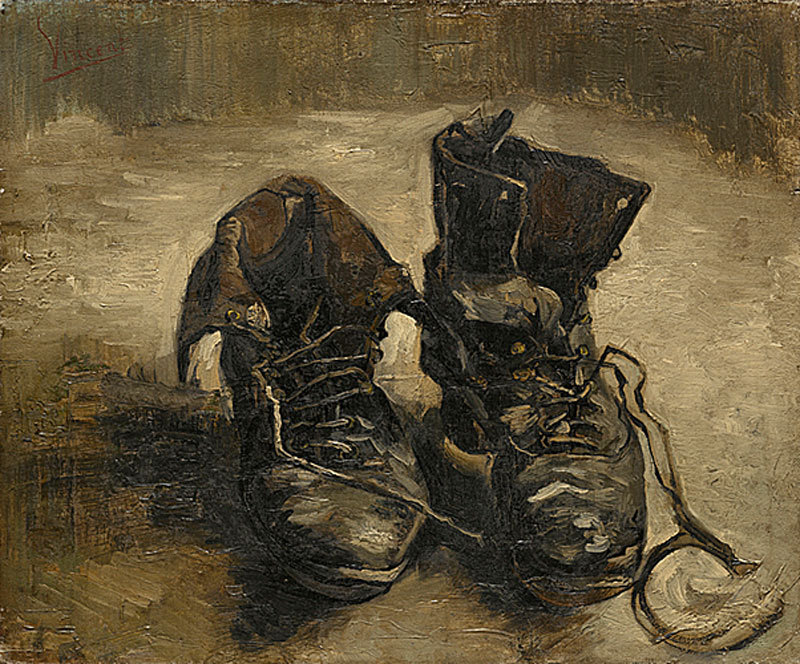 van Gogh, Schuhe
Heidegger und die "Wahrheit" des Werkes
An diesem Punkt, an dem das Trugbild in der Moderne nicht mehr als bloße Täuschung, sondern als produktive Kraft der Bildlichkeit erscheint, stellt sich eine letzte, entscheidende Frage: Kann es überhaupt noch so etwas wie Wahrheit im Bild geben, wenn das Bild nicht mehr Abbild eines Originals ist, sondern selbst Welt erzeugt? Oder anders: Wenn das Simulakrum den Vorrang der absoluten Idee des Wahren, Schönen und Guten zerstört, bleibt dann nur Beliebigkeit, endlose Zirkulation, reine Oberfläche – oder eröffnet sich ein neuer Begriff von Wahrheit, der gerade im Bildhaften selbst gründet?
Hier gewinnt Martin Heideggers berühmter Aufsatz "Der Ursprung des Kunstwerkes" eine große, aber auch irritierende Bedeutung. Heidegger führt die Diskussion um Bild und Wahrheit in eine Richtung, die Wahrheit nicht länger als Richtigkeit begreift – also als Übereinstimmung von Vorstellung und Sache, von Bild und spiritueller Wirklichkeit –, sondern als Unverborgenheit (aletheia). Wahrheit ist bei Heidegger nicht das korrekte Spiegelbild eines bereits vorhandenen Seins, sondern ein Geschehen: ein Ereignis des Sichtbarwerdens, in dem etwas überhaupt erst als Seiendes hervortritt.
Damit verschiebt sich die gesamte Logik der Bildkritik. Ein Kunstwerk ist nicht wahr, weil es „richtig“ abbildet, sondern weil es eine Wirklichkeit eröffnet, die ohne dieses Werk nicht in derselben Weise existieren würde. Das Werk ist nicht sekundär gegenüber einem Urbild, sondern wird selbst zum Ursprung einer Ordnung des Sichtbaren. Es stellt nicht etwas dar, sondern es "stellt Wahrheit auf". Heidegger löst damit die metaphysische Hierarchie von Original und Kopie nicht einfach auf, sondern ersetzt sie durch eine andere Achse: Wahrheit ist nicht mehr das Maß des Bildes, sondern das Bild – genauer: das Werk – wird zum Ort, an dem Wahrheit geschieht.
Gerade für eine Theorie des Trugbildes ist dies entscheidend. Denn Heidegger rehabilitiert – ohne es so zu nennen – die produktive Macht des Bildes: Nicht als trügerische Verführung, sondern als welterzeugende Kraft. Das Kunstwerk ist nicht der Schatten an der Höhlenwand, sondern die Öffnung eines Raumes, in dem Dinge Bedeutung gewinnen, in dem ein Horizont von Sinn, Wert, Gestalt und Anwesenheit entsteht. Heidegger nennt diesen Horizont „Welt“. Welt ist nicht die Summe von Gegenständen, sondern die Ordnung, in der etwas überhaupt als bedeutsam erscheint: eine geschichtliche Konstellation von Sprache, Praxis, Göttern, Institutionen, Möglichkeiten. Zugleich insistiert Heidegger darauf, dass das Werk nicht nur Welt eröffnet, sondern auch „Erde“ hervorbringt: das Widerständige, Dunkle, Materiale, das sich nie restlos ausdeuten lässt – Stein, Farbe, Klang, Leiblichkeit. Im Werk geraten Welt und Erde in einen Streit, und in diesem Streit ereignet sich Wahrheit. Als Idealtypus dieses sich Ereignen von Wahrheit stellt sich für Heidegger der griechische Tempel dar, den er übrigens in vielfacher Ausprägung während seiner Griechenlandreise vor Ort kennenlernte (6).
Diese Konzeption ist in ihrer Konsequenz eine radikale Umwertung der Bildfrage. Platon hatte das Bild nur eine geringe Seinswirklichkeit zugesproche. Heidegger hingegen löst den Wahrheitsanspruch vom Urbild, von der Idee ab: Das Werk ist nicht wahr, weil es an einem transzendenten Maßstab teilhat, sondern weil es eine geschichtliche Unverborgenheit stiftet. In dieser Hinsicht steht Heidegger – bei aller Distanz – näher bei der modernen Affirmation des Simulakrums, als es zunächst scheint: Auch hier ist das Bild nicht bloße Reproduktion, sondern Produktion. Auch hier ist das Bild nicht der Abglanz einer höheren Wahrheit, sondern die Bühne, auf der Wahrheit überhaupt erst entsteht.
Und doch markiert Heidegger zugleich die Grenze jener modernen Euphorie, die das Trugbild nur noch als freies Spiel der Differenzen feiert. Denn Wahrheit als Unverborgenheit ist bei Heidegger niemals reine Öffnung, niemals grenzenlose Vielheit. Sie ist immer zugleich Verbergung. Wo etwas sichtbar wird, wird anderes unsichtbar. Jede Weltaufstellung ist zugleich eine Weltverstellung: eine Ordnung, die Sinn schafft, aber auch Sinn schließt. Heidegger insistiert darauf, dass Unverborgenheit nie total ist, nie vollständig verfügbar. Wahrheit ist sozusagen der ereignishafte Triumph des Lichtes, ein Spiel von Entbergen und Verbergen.(7)
Gerade darin liegt die ambivalente Größe dieses Wahrheitsbegriffs: Er macht verständlich, dass Bilder nicht einfach „unwahr“ sind, nur weil sie nicht abbilden – und zugleich macht er verständlich, warum Bilder nicht harmlos sind, nur weil sie „frei“ sind. Wenn Kunst Wahrheit stiftet, dann stiftet sie nicht bloß Möglichkeiten, sondern sie stiftet Wirklichkeit. Sie eröffnet nicht nur Spielräume, sondern sie setzt Horizonte. Das Bild – als Werk – ist nicht bloß ein Medium, sondern eine Macht.
Damit wird eine Problematik sichtbar, die sich wie ein Schatten durch Heideggers "Ästhetik" (er selbst hat es abgelehnt, von "Ästhetik" zu sprechen) zieht: die Gefahr einer erneuten Sakralisierung des Kunstwerks. Was bei Platon die Idee war, droht bei Heidegger das Werk zu werden: eine Instanz, die nicht mehr kritisiert, sondern ehrfürchtig anerkannt wird. Zwar entzieht Heidegger dem Werk die religiöse Transzendenz, doch er gibt ihm eine ontologische Würde zurück, die beinahe kultisch wirkt. Die Wahrheit, die im Werk geschieht wird nicht mehr "bloß" als freie Imagination verstanden, sondern als Ereignis, das Welt gründet.
Hier entsteht eine Spannung zu der von Deleuze affirmierten Logik des Simulakrums. Deleuze hatte im Simulakrum gerade die Kraft gesehen, Hierarchien zu zersetzen, Differenzen zu vervielfältigen, Metamorphosen zu ermöglichen. Heidegger dagegen denkt das Werk nicht als rhizomatische Explosion von Differenz, sondern als geschichtliche Setzung eines Sinnhorizontes. Das Werk eröffnet nicht unendlich viele Welten zugleich, sondern stiftet eine Welt, die bindet, ordnet, sammelt. In dieser Hinsicht wirkt Heideggers Wahrheitsbegriff wie eine große Gegenbewegung zur modernen Entfesselung des Bildes: ein Versuch, dem Bild wieder Schwere, Ursprung, Boden zu geben.
Und dennoch ist es gerade diese Schwere, die Heideggers Begriff im Zeitalter der Simulation so brisant macht. Denn nach Baudrillard ist die moderne Welt nicht mehr von Werken geprägt, die Wahrheit aufstellen, sondern von Zeichenströmen, die sich endlos replizieren. Das Bild wird nicht mehr als Ort der Welteröffnung erfahren, sondern als Oberfläche der Zirkulation: Memes, Werbung, Social-Media-Feeds, algorithmische Bildmaschinen, KI. Bilder bilden nicht mehr ab, aber sie eröffnen auch nicht notwendig Welt – sie erzeugen Aufmerksamkeit, Affekt, Konsum, Geschwindigkeit. Die Frage lautet dann nicht mehr: Was zeigt das Bild? sondern: Was bewirkt es? Nicht mehr: Welche Wahrheit ereignet sich? sondern: Welche Operation wird ausgeführt?
Heideggers Wahrheitsbegriff erscheint hier zugleich als Rettung und als Nostalgie. Rettung, weil er an eine Dimension erinnert, die im digitalen Bilderstrom verloren zu gehen droht: dass ein Bild mehr sein kann als Information, mehr als Oberfläche, mehr als Effekt. Nostalgie, weil sein Modell des Werkes – das Werk als Ursprung, als Stiftung einer Welt – in einer Epoche, in der Bilder massenhaft und anonym zirkulieren, fast wie eine Erinnerung an eine vergangene Sakralität wirkt. Man könnte sagen: Heidegger formuliert den Ernst einer Bildwahrheit in einem Moment, in dem das Bild bereits dabei ist, sich in reine Zirkulation zu verwandeln.
Gerade daraus ergibt sich jedoch ein produktiver Schluss für die moderne Neubewertung des Trugbildes. Denn Heidegger erlaubt, den Wahrheitsbegriff so zu verschieben, dass er nicht mehr gegen das Trugbild ausgespielt werden muss. Wahrheit ist nicht das Gegenteil von Bildhaftigkeit, sondern ihr Modus. Das Trugbild ist nicht einfach die Abwesenheit von Wahrheit, sondern kann – im besten Fall – ein Ereignis sein, in dem Welt neu entsteht. Die Frage ist nicht, ob das Bild wahr oder falsch ist, sondern welche Welt es eröffnet, welche Ordnung es setzt, welche Sichtbarkeit es ermöglicht und welche es blockiert.
Damit erhält auch die Re-Fabulierung der Welt einen neuen Ernst. Sie ist nicht bloß ästhetisches Spiel, nicht bloß Variation ohne Verpflichtung, sondern ein Eingriff in die Bedingungen dessen, was als wirklich gelten kann. Im Trugbild entscheidet sich nicht nur die Freiheit der Imagination, sondern die Architektur des Sinns. Jedes Simulakrum ist eine Setzung: Es entwirft eine Welt, in der bestimmte Dinge sichtbar werden – und andere verschwinden. Die schöpferische Kraft des Trugbildes ist damit immer auch eine gefährliche Kraft: Sie kann öffnen, aber auch schließen; sie kann befreien, aber auch bannen; sie kann Differenz hervorbringen, aber auch neue Dogmen in ästhetischer Form errichten.
So lässt sich am Ende sagen: Die Moderne hat das Trugbild nicht einfach rehabilitiert, sondern es zum Grundmodus ihrer Wirklichkeit gemacht. Was bei Platon als dämonische Abweichung erschien, ist zur Regel geworden: Bilder, die nicht mehr auf ein Urbild verweisen, sondern selbst Ursprung sind. Deleuze erkennt darin die produktive Macht der Differenz; Baudrillard warnt vor der totalen Simulation; Heidegger schließlich zeigt, dass das Bild nicht nur Oberfläche ist, sondern ein Ort der Wahrheit – nicht als Übereinstimmung, sondern als Ereignis.
Doch diese Wahrheit ist nicht garantiert. Sie ist kein Besitz, kein Fundament, kein metaphysischer Halt. Sie geschieht – und kann misslingen. In dieser Offenheit liegt die Chance und das Risiko der Moderne: Die Welt ist nicht mehr durch ein einziges Licht geordnet, sondern wird in unzähligen Bildereignissen immer wieder neu entworfen.
Das Trugbild ist damit nicht bloß das Ende der Wahrheit, sondern die Bedingung einer anderen Wahrheit: einer Wahrheit, die nicht hinter dem Bild liegt, sondern in ihm entsteht – als fragile, konflikthafte, geschichtliche Unverborgenheit. Und gerade deshalb ist das Trugbild nicht harmlos. Es ist nicht nur Spielraum der Kunst, sondern die Bühne, auf der sich entscheidet, welche Welt wir bewohnen können.
Heidegger und van Goghs Schuhe?
Im Ursprung des Kunstwerkes sucht Heidegger nach einem Wahrheitsbegriff, der das Bild endgültig aus der platonischen Logik befreit. Wahrheit ist nicht länger Richtigkeit, nicht die Übereinstimmung von Abbild und Urbild, sondern Unverborgenheit (aletheia): ein Geschehen, in dem sich Welt öffnet. Um diesen Gedanken zu erden, greift Heidegger zu einem scheinbar trivialen Motiv: Vincent van Goghs Gemälde eines Paares Schuhe.
Gerade diese Wahl ist bezeichnend. Denn Schuhe sind kein erhabenes Objekt, kein religiöses Symbol, kein ikonisches Herrschaftszeichen. Sie sind "Zeug", Gebrauchsgegenstand, Abnutzung, Materialität. Und doch behauptet Heidegger: In ihnen kann Wahrheit aufscheinen – nicht als Abbildung, sondern als Ereignis. Das Werk zeigt nicht „Schuhe“, sondern lässt eine ganze Welt hervortreten.
„Zeug“ und Welt
Nach Heidegger stellt das Werk nicht etwas vor, sondern auf.
In der Darstellung der Schuhe ereignet sich eine Welt: Arbeit, Weg, Wetter, Erde, Mühsal, Sorge. Nicht als hinzugefügte Interpretation, sondern als Sinnhorizont.
So werden die Schuhe zu einem Knotenpunkt von Verweisungen: Sie tragen angeblich noch Reste der Erde, sie sind vom Gang gezeichnet, sie sind in eine Lebensform eingelassen. Heidegger nennt dies die Struktur des Zeugs: Es ist nicht bloß vorhanden, sondern eingebunden in eine Praxis, in ein Leben.
In dieser Lesart wird das Bild zum Gegen-Platonismus: Nicht Schatten, nicht Trug, sondern Wahrheit – nicht hinter dem Bild, sondern im Bild.
Die Bäuerin als Ursprung
Denn Heidegger belässt es nicht dabei, dass Schuhe „Zeug“ sind. Er schreibt ihnen eine Besitzerin zu: eine Bäuerin. Aus dieser Zuschreibung entfaltet er eine Szene, die so eindringlich ist, dass sie sich wie eine zweite Bildschicht über das Gemälde legt: das Feld, die Furchen, die Schwere der Erde, die stumme Härte der Arbeit.
Damit verwandelt sich das Bild in eine ontologische Erzählung. Heidegger liest aus den Schuhen eine Welt heraus, die er in sie hineinsieht: eine Welt der Erdverbundenheit, der Einfachheit, der ursprünglichen Nähe zum Sein. Die Wahrheit des Werkes erscheint als Rückkehr zu einer „eigentlichen“ Ordnung.
Gerade darin liegt eine heimliche Restitution des Metaphysischen: nicht mehr als Idee, sondern als Herkunft; nicht mehr als Urbild, sondern als Ursprungston. Das Werk soll nicht einfach Differenzen freisetzen, sondern eine Welt stiften, die sammelt, bindet, trägt.
Heideggers Wahrheit gewinnt Gravitation – und diese Gravitation hat einen Preis.
Derridas Einspruch: Wem gehören die Schuhe?
Jacques Derrida hat diese Passage in Die Wahrheit in der Malerei nicht zufällig zum Kristallisationspunkt einer großen Auseinandersetzung gemacht. Sein Einwand trifft nicht nur Heideggers „Interpretation“, sondern die Struktur seines Wahrheitsanspruchs.
Denn was, wenn die Schuhe gar nicht der Bäuerin gehören?
Was, wenn es van Goghs eigene Schuhe sind, wie es der amerikanische Kunsthistoriker Meyer Shapiro nahelegt. (8)
Dann bricht Heideggers Szene nicht einfach als Faktum zusammen, sondern als philosophische Operation. Jedoch: Hängt Heideggers Wahrheit an einer Besitzfrage, an einer Herkunftszuschreibung: Wer trug diese Schuhe? Welche Welt gehört ihnen? Welche Welt darf aus ihnen hervorgehen?
Derridas Pointe ist dabei nicht: Heidegger habe sich „geirrt“.
Sondern: Die Wahrheit des Werkes ist nicht unabhängig von Rahmung, Zuschreibung, Kontext. Das Werk ist kein reines Ereignis, sondern ein Ort, an dem Signaturen, Autoritäten, diskursive Entscheidungen
wirksam werden.
Das Bild ist nicht einfach Offenbarung – es ist auch ein oft verhüllter Kampfplatz.
Die Schuhe sind kein Ursprung, sondern ein Simulakrum
Was ist ein Simulakrum? Nicht das falsche Bild, nicht die minderwertige Kopie. Sondern eine Bildform, die gerade dadurch mächtig wird, dass sie nicht mehr auf ein Urbild zurückgeführt werden kann. Das Simulakrum ist nicht defizitär, sondern produktiv: Es erzeugt Differenz, es stiftet Serien, es entzieht sich dem Urteil des „Ähnlichen“.
Genau das geschieht bei van Goghs Schuhen – vielleicht gegen Heideggers Intention.
Denn die Schuhe sind „Zeug“, das auf eine Welt verweist und stellen gleichzeitig eine Differenzmaschine dar:
-
Bäuerin oder Maler.
-
Feld oder Stadt.
-
Arbeit oder Armut.
-
Erde oder Atelier.
-
„Wahrheit“ oder „Fiktion“.
Die Schuhe sind nicht ein Zeichen, das zu einem Ursprung zurückführt, sondern ein Bild, das Serien produziert. Es ist nicht die Rückbindung an Herkunft, sondern die Entfesselung von möglichen Welten.
Heidegger will aus dem Werk eine Welt destillieren.
Deleuze sieht im Werk die Vervielfältigung der Welt.
Damit verschiebt sich die Wahrheit selbst: Sie ist nicht mehr die Eröffnung einer „eigentlichen“ Welt, sondern die Produktion von Differenzen, die das Werk in Gang setzt. Wahrheit ist nicht Sammlung, sondern Streuung. Nicht Ursprung, sondern Abzweigung. Nicht Erde als Fundament, sondern Erde als Material der Metamorphose.
Wessen Schuhe sind das wirklich?
Welche Wirklichkeiten werden durch dieses Bild möglich?
Heideggers Lesart bindet die Schuhe an eine Identität: Bäuerin, Feld, Erde, Ursprung.
Diese Unsicherheit ist kein Mangel, sondern die Bedingung der Bildmacht.
Die Schuhe sind nicht wahr, weil sie zu einer Welt gehören, sondern weil sie Welten erzeugen, als Bewegung, als Differenz, als Erscheinung, vielleicht sogar als Offenbarung.
Simulakrum als Ent-Identifizierung
Heideggers Wahrheit ist weltbildend – und damit auch weltbindend. Das Werk „stellt eine Welt auf“: Es stiftet Ordnung, Horizont, Schicksal. Doch im Simulakrum geschieht das Gegenteil: Es entzieht der Welt ihre letzte Bindung, es macht sie variabel, kombinierbar, montierbar, remixbar.
Das Bild wird nicht zum Fundament, sondern zur Fuge: zu einer Stelle, an der Bedeutungen auseinandergehen und neu ansetzen. Das Werk ist nicht mehr Ursprung, sondern Knotenpunkt. Nicht mehr Heimat, sondern Passage.
Gerade darum sind van Goghs Schuhe nicht das Bild einer ursprünglichen Erdexistenz, sondern ein Emblem der Moderne selbst: ein Objekt, das seine Herkunft nicht preisgibt und gerade dadurch anschlussfähig wird.
Trugbild Wahrheit Differenz
Heidegger "rettet" das Bild aus dem Platonismus, indem er es als Wahrheitsereignis denkt. Aber er versucht zugleich, diese Wahrheit weiter zu stabilisieren – durch Welt, Erde, Ursprung, Zugehörigkeit. Derrida zeigt die Fragilität dieser Stabilisierung.
Die Schuhe sind nicht die Wahrheit der Bäuerin.
Die Schuhe sind nicht die Wahrheit van Goghs.
Die Schuhe sind nicht die Wahrheit eines Ursprungs.
Sie sind die Wahrheit des Bildes als Bild: ein Simulakrum, das keine letzte Referenz braucht, um wirklich zu sein.
Damit wird das Trugbild rehabilitiert – nicht als Illusion, sondern als schöpferische Macht. Nicht als Schatten, sondern als Differenz. Nicht als Abfall vom Sein, sondern als das, worin Sein überhaupt erst variieren kann.
Das Simulakrum ist nicht die Lüge der Kunst.
Es ist ihre Wahrheit: die Wahrheit, dass Welt nicht gegeben ist, sondern gemacht wird – in Serien, Brüchen, Wiederholungen.
Aber kann man das noch als "Trugbild" bezeichnen?
Trugbild heute
Der Surrealismus ging einen Schritt weiter, indem er das Traumhafte, das Phantasma selbst zur Methode erhob. Dalís „paranoisch-kritische Methode“ oder die automatischen Zeichnungen Massons machten das Trugbild zum Motor des Schaffens. Hier ging es nicht mehr darum, eine sichtbare Realität darzustellen, sondern eine unsichtbare zu evozieren. Das Bild wurde zur Simulation, zur dionysischen Maschine, die eine Welt gebar, die nicht mehr an die Unterscheidung zwischen Wirklichkeit und Vorstellung gebunden war.
In der Postmoderne schließlich zeigt sich das Trugbild als allgegenwärtiges Prinzip. Warhols Marilyn-Serien vervielfältigen ein Bild, bis es seinen Bezug zum Original verliert. Es bleibt nur die Wiederholung, die Serie, die Oberfläche. Das vermeintliche „Ebenbild“ der Schauspielerin ist längst selbst zum Simulakrum geworden: ein Bild ohne Ursprung, das dennoch eine enorme Wirklichkeit besitzt. Cindy Sherman hat diesen Gedanken in ihren „Untitled Film Stills“ weitergetrieben, indem sie Bilder von Bildern von Bildern inszenierte – Archetypen des Weiblichen, die keine Referenz mehr haben, außer auf die Bildkultur selbst.
Auch in der Architektur oder im Design begegnen wir dem Trugbild. Las Vegas, von Robert Venturi und Denise Scott Brown analysiert, ist eine Stadt aus Zeichen, Simulationen, Oberflächen, die keinen Anspruch auf Authentizität erheben und gerade dadurch ihre Kraft entfalten. In ähnlicher Weise kann man in der zeitgenössischen digitalen Kunst beobachten, wie virtuelle Räume und Avatare entstehen, die nicht Abbild einer „wirklichen“ Welt sind, sondern eine Realität eigener Ordnung, deren Wahrheit allein in der Intensität der Erfahrung liegt.
Das Trugbild erweist sich so als durchgängiges Prinzip künstlerischer Praxis. Es bringt Schichtungen hervor, in denen das Alte nicht verschwindet, sondern in neuen Konstellationen wiederkehrt. Ein gotisches Ornament taucht in einer postmodernen Collage auf, ein Fragment religiöser Ikonographie wird in der Popkultur ironisch zitiert, ein Werbebild wird zum Material für politische Kunst. Die Oberfläche ist nicht leer, sondern voller Spuren, voller Überlagerungen, voller Möglichkeiten.
Für den Künstler bedeutet dies keine Kapitulation vor Beliebigkeit, sondern die Freiheit, das zu wählen, was ihn affiziert. Das Beliebige ist nicht „egal welches“, sondern genau das, was in einer bestimmten Konstellation Resonanz erzeugt. In dieser Praxis bleibt eine Wehmut spürbar – das Wissen, dass es keine letzte Wahrheit mehr gibt –, und doch verwandelt sich diese Wehmut in Energie. Denn die verlorene Wahrheit ist zugleich das offene Feld, in dem die Macht der Einbildungskraft walten kann.
Das Trugbild ist damit kein Täuschungsmanöver, sondern die eigentliche Form künstlerischer Wahrheit. Es erlaubt, Welten neu zu fabulieren, Masken aufzusetzen und wieder abzunehmen, Bilder zu kombinieren, bis aus der Vielfalt ein neuer Zusammenhang entsteht. Ob in der Collage, im Film, in der Performance oder in digitalen Simulationen: Die Kunst lebt davon, dass hinter jeder Schicht eine andere wartet, hinter jeder Maske eine neue.
(1) Gilles Deleuze, Logik des Sinns, Frankfurt 1993, S. 311 (Platon und das Trugbild)
(2) Petrarca, Das einsame Leben,
(3) siehe dazu: Hans Belting, Bild und Kult - Eine Geschichte des Bildes vor dem Zeitalter der Kunst, München 2000
(4) Gilles Deleuze, a.a.O., S. 315
(5) Giorgio Agamben, Die kommende Gemeinschaft, Berlin 2003, S. 9 (Beliebiges)
(6)
(7) siehe dazu auch Heideggers Begriff des "Raum-Zeit-Spieles"
Phantasm
“Bring on the beautiful illusions! Let us be deceivers and embellishers of humanity!”
Friedrich Nietzsche
Gilles Deleuze has highlighted the distinction between the archetype/image on the one hand and the illusion/simulacrum on the other, and has shown that Plato’s devaluation is directed more toward the illusion than toward the archetype. (1)
Modernity, understood, among other things, as the age of the dissolution of metaphysical hierarchies, is no longer founded on the distinction between original and image, but on the equivalence, indeed the indistinguishability, of reality and image. In this sense, the simulacrum is not mere illusion or deception, but a productive, creative force that opens up the imaginary space in which difference, multiplicity, and metamorphosis come into play.
Plato: Truth – Phantasm
For Plato, the image is always the “image of an image”—an image that has lost its connection to the Idea and moves within the realm of the merely pictorial, indeed the fantastical, the fleeting, illusory. It is an image that seduces humans by obscuring the order of ideas. Just as in the Allegory of the Cave the shadows on the wall keep the prisoners from the light of the True, so the phantasma is that which distances humans from the “absolutely Good.”
This distinction implies a fundamental judgment: truth is linked to the Idea, error and seduction to the image. Within this duality, the metaphysical tradition of the West took shape, channeling the productive power of the imagination—the “power of the imagination”—over the course of centuries. This does not mean, however, that imagination did not exist outside of Platonic metaphysics: for example, in the Saturnalia, theatrical culture with its tragedies and comedies, processions, Dionysian cults, etc.
But could one not also describe the Platonic absolute Good and Beautiful as a phantasm (illusion)—and in particular, his philosophy of images could be described as an immunization strategy against the great virtues of illusions that Plato himself cites: enthusiasm, not only in the artist but also in the audience, rapture, etc.
Middle Ages: Delusion and Truth
Christian tradition has also taken up this line of thought. Petrarch, for example, following in the Augustinian tradition, warns against the destructive power of “inner images”:
“Countless apparitions and images of visible things accumulate, which, after entering individually through the senses, condense in great numbers in the depths of the soul; and since the soul is neither made for this nor capable of receiving such a multitude, it is weighed down and confused. Therefore, your thinking is contaminated and torn apart by those pathological delusions which, with their deadly diversity, block the path to clarifying contemplations through which one ascends to the one and highest light.” (2)
The multitude of images is regarded as a threat to spiritual concentration because it obstructs the ascent to truth—in Augustine’s case, of course, God.
In the Christian medieval tradition, however, the question of the truth of (religious) images occupies an ambivalent position. While, on the one hand, the deluge of internal and external images was regarded as a danger to spiritual concentration and the ascent to the vision of God, on the other hand, the religious image—such as the image of Christ, the icon, or the painting of the Madonna—was valued precisely as a mediation between the visible and the invisible. Augustine himself distinguished between signs that lead to the truth and those that distract from it. For him, the true image was not primarily a representation of the world, but a pointer to the heavenly, to the transcendent. In religious worship, this gave rise to a practice of imagery that sought to banish the illusion by liturgically and symbolically ordering it toward a higher truth. The icon was not regarded as an illusory representation, but as a passageway for the sacred, as a window to the light of the beyond. The controversy over iconoclasm in the Byzantine Empire shows how contentious this question was: Is the image grace or temptation? A path to God or a detour? (3)
Luther and Reformation Skepticism Toward Images
Martin Luther gave this tension a new twist in the 16th century. His criticism of the veneration of images was directed less at the image itself than at the act of worship. Images, according to Luther, were permissible as didactic and mnemonic aids, as long as they did not become the object of faith. This shifts the focus: it is not the image itself that is the problem, but the human tendency to idolize the visible. In his treatise “Against the Heavenly Prophets” (1525), he emphasizes that the “true image of Christ” is the Word—the living, preached Gospel. The visible image is at most a tool, never revelation itself.
Luther himself expressly opposed violent iconoclasm, as demanded by more radical reformers. He rejected the veneration of images, but not their mere existence. For him, they had educational and commemorative value, as long as they were not elevated to cultic status. Luther did not want to tear down images, nor did he want to erect new ones.
Zwingli and Calvin, on the other hand, took a completely different view. Both saw the visible as a potential temptation that distracts faith from the invisible truth. In Zurich and Geneva, systematic removal of images and a radical simplification of the church interior actually took place. Here, criticism turned into a genuine iconoclasm, a symbolic purification of the space of faith from any material mediation. In the Lutheran tradition, however, the image—in the form of altarpieces, woodcuts, or Bible illustrations, for example—remained present.
Deleuze and Baudrillard
Deleuze recognizes in the simulacrum a productive force of difference that dissolves hierarchies and instead multiplies differences.
"The Catechism, so heavily influenced by Platonism, has familiarized us with the following phrase: God created man in his image and likeness, yet through the Fall, man lost the likeness but retained the image. We have become illusions;
we have lost moral existence to enter into an aesthetic existence. The catechism’s remark is characterized by its emphasis on the demonic nature of the illusion. (4)
While Deleuze still sees in the simulacrum a creative, ontologically open movement, Baudrillard recognizes in it the turning point toward a world of total signs: Simulation replaces the real until the original disappears. In “Simulacres et Simulation” (1981), he distinguishes four stages of the image: First, it reflects a reality; then it distorts it; then it conceals the absence of reality; and finally, it itself becomes a reality without reference.
I
Thus, the simulacrum becomes fully autonomous. In the age of simulation, images circulate that no longer depict a world but generate a world themselves. But can one even speak of a “simulacrum” anymore? Baudrillard’s “hyperreality” is the culmination of the dynamic described by Deleuze: difference and repetition tip over into endless reproduction.
Imagination, Truth, and Arbitrariness
The millennia-old devaluation of the illusion has shaped the history of imagination: The “correct” image (likeness) was recognized as sensory knowledge, while imagination was dismissed as mere trickery. In large areas of modernity, however, it becomes apparent that imagination—as the productive force of collage, connection, and variation—carries the true richness of the pictorial.
This also shifts the concept of truth. If there is no absolute truth, as Nietzsche puts it, then there is no lie either. “With the true world, we have also abolished the apparent.”
What remains is the task of “re-fabulating the world”—that is, of inventing it anew again and again in the mode of the simulacrum.
The “arbitrariness” of modernity, so often lamented, proves in this light to be an ambivalent phenomenon: it signifies not only a loss of truth, but also a gain in possibility. The arbitrary, as Agamben emphasizes, is not merely “anything goes,” but “that which is, which is generally popular”—a form of desire, of the singular, which unfolds precisely in diversity. (5)
Photography
The invention of photography brought a new dimension to the discussion of the pictorial. For a long time, it was regarded as a privileged access to reality, as a quasi-objective trace of reality. But here, too, criticism soon set in.
Roland Barthes, who is most likely to grant photography this “access to reality,” analyzes photography in *Camera Lucida* as a place of melancholy: an image that shows that “it has been,” but at the same time marks what is shown as lost. Susan Sontag criticizes the camera as an apparatus of appropriation that divides the world into consumable fragments. The photographic image appears objective, but is always already an aesthetically and culturally preformed illusion.
Vilém Flusser sees in technical photography a new magical image: the camera as an apparatus programs the image; the photographer is a player, not a creator. With digitization, this development is radicalized. The digital image is no longer a light trace, but a code. Boris Groys sees in digital images a new iconoclastic age: images circulate without representing.
The Power of the Illusion
For art, the illusion does not signify a betrayal of truth, but rather the unfolding of its true power. Collage, montage, simulation—all these are strategies that affirm the simulacrum. They do not merely produce images of a world, but create new worlds, new orders of the visible.
The avant-gardes of the 20th century already demonstrated this radically. The Dadaists cut up newspaper, advertising posters, and everyday scraps and reassembled them. Surrealism made the phantasm itself a method. In postmodernism, artists present the image as a series, as repetition, as pure surface.
The Magic of the Image
In early cultures, the image itself was still part of the being it depicted. It was representation, but also presence. The early cultic image possessed efficacy, image magic—it was not a symbol but an action, not a reference but reality—on the rock walls of cave paintings, often deep within the mountain; in the statue of the deity; in the mask of ritual. This archaic image magic, which implies that the image itself is what it depicts, still echoes in the Christian iconographic tradition: for example, in the cult of the “Black Madonnas” at the famous Marian pilgrimage sites. The latter have always been and continue to be viewed with a certain skepticism by official theology, for even the “miraculous image of Mary” is always merely a reference to the deity, not the deity itself; otherwise, there would be no difference from the ancient “idol,” which early Christianity both abhorred and transposed. For example, the Roman imperial portrait served as the model for the “Christ Pantocrator” in icon painting.
But also in the repeatedly—and unsuccessfully—criticized fascination with the flood of digital images and videos (memes, GIFs, Reels, Stories, etc.): People are online 24 hours a day, day after day, hoping to catch a glimpse of the digital ambrosia that modern influencer demigods consume daily in the form of millions of likes.
An Expanded Concept of Autonomy
The illusion is the fate of modernity—and its opportunity. By subverting the hierarchy of original and copy, being and appearance, truth and deception, it opens up a perspective in which the world itself can be experienced as a phantasm, as a collage, as a harlequin’s cloak.
Following the theological demystification of images, which originated in Protestantism, and the philosophical dissolution of hierarchies in Deleuze and Baudrillard, modernity is characterized by a new form of image production: the image has fully emancipated itself. It is no longer an expression of divine truth, but a medium of itself. The glorification of God becomes, on the one hand, an “autonomous” medial self-reference, but on the other hand also a play on the meanings of the image.
Just as Luther separated the image from worship and Baudrillard detaches simulation from reality, the relationship between human and image transforms into a mutual generation. The image is no longer merely a mirror or a sign, but a place where the world comes into being. The re-fabulation of the world in the mode of the simulacrum is thus the secular continuation of the theological task: human imagination instead of divine creation, creation instead of revelation.
However, only “dead” images—which are not real life. That would remain—if at all—the preserve of already highly advanced genetic engineering.
Heidegger and the “Truth” of the Work
At this point, where the illusion in modernity no longer appears as mere deception but as a productive force of imagery, a final, decisive question arises: Can there even still be such a thing as truth in the image if the image is no longer a representation of an original but generates the world itself? Or to put it another way: If the simulacrum destroys the primacy of the absolute idea of the True, the Beautiful, and the Good, does only arbitrariness, endless circulation, and pure surface remain—or does a new concept of truth emerge, one grounded precisely in the pictorial itself?
Here, Martin Heidegger’s famous essay “The Origin of the Work of Art” takes on a profound yet unsettling significance. Heidegger steers the discussion of image and truth in a direction that no longer conceives of truth as correctness—that is, as the correspondence between conception and thing, between image and spiritual reality—but rather as unconcealment (aletheia). For Heidegger, truth is not the correct reflection of an already existing being, but an event: an occurrence of becoming visible, in which something emerges as being at all.
This shifts the entire logic of image criticism. A work of art is not true because it depicts “correctly,” but because it opens up a reality that would not exist in the same way without this work. The work is not secondary to an archetype, but becomes itself the origin of an order of the visible. It does not represent something, but “establishes truth.” Heidegger thus does not simply dissolve the metaphysical hierarchy of original and copy, but replaces it with a different axis: truth is no longer the measure of the image, but the image—more precisely: the work—becomes the place where truth occurs.
This is particularly crucial for a theory of the illusion. For Heidegger rehabilitates—without calling it that—the productive power of the image: not as a deceptive seduction, but as a world-creating force. The work of art is not the shadow on the cave wall, but the opening of a space in which things gain meaning, in which a horizon of sense, value, form, and presence emerges. Heidegger calls this horizon “world” . The world is not the sum of objects, but the order in which something appears meaningful at all: a historical constellation of language, practice, gods, institutions, possibilities. At the same time, Heidegger insists that the work not only opens up the world, but also brings forth “earth”: the resistant, dark, material, that which can never be fully interpreted—stone, color, sound, corporeality. In the work, world and earth enter into a conflict, and in this conflict truth occurs. For Heidegger, the Greek temple presents itself as the ideal type of this occurrence of truth; incidentally, he encountered it in various forms during his trip to Greece (6).
In its logical consequence, this conception constitutes a radical reevaluation of the question of the image. Plato had attributed only a minimal reality of being to the image. Heidegger, on the other hand, detaches the claim to truth from the archetype, from the Idea: the work is not true because it participates in a transcendent standard, but because it creates a historical unconcealment. In this respect, Heidegger—despite all his distance—stands closer to the modern affirmation of the simulacrum than it initially appears: Here, too, the image is not mere reproduction, but production. Here, too, the image is not the reflection of a higher truth, but the stage upon which truth comes into being in the first place.
And yet Heidegger simultaneously marks the boundary of that modern euphoria which celebrates the illusion merely as a free play of differences. For truth as unconcealment is never, in Heidegger, pure opening, never boundless multiplicity. It is always, at the same time, concealment. Where something becomes visible, something else becomes invisible. Every world-setting is at the same time a world-concealment: an order that creates meaning, but also excludes meaning. Heidegger insists that unconcealment is never total, never fully available. Truth is, so to speak, the eventful triumph of light, a play of unveiling and concealing.(7)
It is precisely here that the ambivalent greatness of this concept of truth lies: it makes it understandable that images are not simply “untrue” just because they do not depict—and at the same time, it makes it understandable why images are not harmless just because they are “free.” If art creates truth, then it creates not merely possibilities, but reality. It opens up not only spaces for play, but sets horizons. The image—as a work—is not merely a medium, but a power.
This reveals a problem that casts a shadow over Heidegger’s “aesthetics” (he himself refused to speak of “aesthetics”): the danger of a renewed sacralization of the artwork. What was the Idea in Plato threatens to become the work in Heidegger: an authority that is no longer criticized but reverently acknowledged. Although Heidegger strips the work of its religious transcendence, he restores to it an ontological dignity that has an almost cultic effect. The truth that occurs in the work is no longer understood “merely” as free imagination, but as an event that constitutes the world.
Here a tension arises with the logic of the simulacrum affirmed by Deleuze. Deleuze had seen in the simulacrum precisely the power to dissolve hierarchies, multiply differences, and enable metamorphoses. Heidegger, on the other hand, conceives of the work not as a rhizomatic explosion of difference, but as the historical establishment of a horizon of meaning. The work does not open up an infinite number of worlds at once, but rather establishes a world that binds, orders, and gathers. In this respect, Heidegger’s concept of truth appears as a major counter-movement to the modern unleashing of the image: an attempt to restore weight, origin, and grounding to the image.
And yet it is precisely this weight that makes Heidegger’s concept so explosive in the age of simulation. For according to Baudrillard, the modern world is no longer shaped by works that establish truth, but by streams of signs that replicate endlessly. The image is no longer experienced as a place where the world opens up, but as a surface of circulation: memes, advertising, social media feeds, algorithmic image machines, AI. Images no longer represent, nor do they necessarily open up the world—they generate attention, affect, consumption, speed. The question is then no longer: What does the image show? but: What does it effect? No longer: What truth occurs? but: What operation is performed?
Heidegger’s concept of truth appears here as both salvation and nostalgia. Salvation, because it recalls a dimension that threatens to be lost in the digital stream of images: that an image can be more than information, more than a surface, more than an effect. Nostalgia, because his model of the work—the work as origin, as the foundation of a world—in an era in which images circulate en masse and anonymously, seems almost like a memory of a past sacredness. One might say: Heidegger articulates the seriousness of an image’s truth at a moment when the image is already in the process of transforming into pure circulation.
Yet it is precisely from this that a productive conclusion emerges for the modern reevaluation of the illusion. For Heidegger allows us to shift the concept of truth in such a way that it no longer needs to be pitted against the illusion. Truth is not the opposite of pictoriality, but its mode. The illusion is not simply the absence of truth, but can—in the best case—be an event in which the world is newly created. The question is not whether the image is true or false, but what world it opens up, what order it establishes, what visibility it enables, and what it blocks.
This also lends new gravity to the re-fabulation of the world. It is not merely an aesthetic game, not merely a variation without obligation, but an intervention in the conditions of what can be considered real. In the illusion, not only the freedom of the imagination is decided, but the architecture of meaning. Every simulacrum is a positing: it designs a world in which certain things become visible—and others disappear. The creative power of the illusion is thus always also a dangerous power: it can open, but also close; it can liberate, but also banish; it can bring forth difference, but also erect new dogmas in aesthetic form.
Thus, in the end, it can be said: Modernity has not simply rehabilitated the illusion, but has made it the fundamental mode of its reality. What appeared to Plato as a demonic deviation has become the norm: images that no longer refer to an archetype, but are themselves the origin. Deleuze recognizes in this the productive power of difference; Baudrillard warns against total simulation; Heidegger, finally, shows that the image is not merely a surface, but a place of truth—not as correspondence, but as an event.
Yet this truth is not guaranteed. It is no possession, no foundation, no metaphysical anchor. It happens—and can fail. In this openness lies the opportunity and the risk of modernity: The world is no longer ordered by a single light, but is continually redesigned anew in countless image-events.
The illusion is thus not merely the end of truth, but the condition of another truth: a truth that does not lie behind the image, but arises within it—as a fragile, conflict-ridden, historical unhiddenness. And precisely for this reason, the illusion is not harmless. It is not merely the realm of art, but the stage upon which it is decided which world we can inhabit.
Heidegger and van Gogh’s Shoes?
In the origin of the work of art, Heidegger seeks a concept of truth that definitively liberates the image from Platonic logic. Truth is no longer correctness, not the correspondence between image and archetype, but unconcealment (aletheia): an event in which the world opens up. To ground this idea, Heidegger turns to a seemingly trivial motif: Vincent van Gogh’s painting of a pair of shoes.
This choice is particularly telling. For shoes are not a sublime object, not a religious symbol, not an iconic sign of power. They are “stuff,” everyday objects, wear and tear, materiality. And yet Heidegger asserts: Truth can emerge in them—not as a representation, but as an event. The work does not depict “shoes,” but allows an entire world to emerge.
“Stuff” and the World
According to Heidegger, the work does not present something, but rather establishes it.
In the depiction of the shoes, a world unfolds: labor, journey, weather, earth, hardship, concern. Not as an added interpretation, but as a horizon of meaning.
Thus the shoes become a nexus of references: they supposedly still bear traces of the earth, they are marked by walking, they are embedded in a way of life. Heidegger calls this the structure of things: they are not merely present, but integrated into a practice, into a life.
In this reading, the image becomes a counter-Platonism: not shadow, not illusion, but truth—not behind the image, but within the image.
The Peasant Woman as Origin
For Heidegger does not stop at the idea that shoes are “things.” He attributes an owner to them: a peasant woman. From this attribution, he unfolds a scene so vivid that it lays itself over the painting like a second layer of imagery: the field, the furrows, the heaviness of the earth, the silent harshness of labor.
Thus the image is transformed into an ontological narrative. Heidegger reads a world out of the shoes, a world he sees within them: a world of earthiness, of simplicity, of primal closeness to Being. The truth of the work appears as a return to a “true” order.
Precisely therein lies a secret restitution of the metaphysical: no longer as an idea, but as origin; no longer as an archetype, but as a primal tone. The work is not meant simply to release differences, but to create a world that gathers, binds, and sustains.
Heidegger’s truth gains gravity—and this gravity comes at a price.
Derrida’s objection: To whom do the shoes belong?
It is no coincidence that Jacques Derrida made this passage in *Truth in Painting* the focal point of a major debate. His objection targets not only Heidegger’s “interpretation,” but the very structure of his claim to truth.
For what if the shoes do not belong to the peasant woman at all?
What if they are van Gogh’s own shoes, as the American art historian Meyer Shapiro suggests. (8)
Then Heidegger’s scene collapses not merely as a fact, but as a philosophical operation. However: Does Heidegger’s truth hinge on a question of ownership, on an attribution of origin: Who wore these shoes? To which world do they belong? Which world may emerge from them?
Derrida’s point here is not: that Heidegger was “wrong.”
Rather: The truth of the work is not independent of framing, attribution, context. The work is not a pure event, but a site where signatures, authorities, and discursive decisions come into play.
The image is not simply revelation—it is also an often-veiled battlefield.
The shoes are not an origin, but a simulacrum
What is a simulacrum? Not the false image, not the inferior copy. But a form of image that becomes powerful precisely because it can no longer be traced back to an archetype. The simulacrum is not deficient, but productive: it generates difference, it creates series, it eludes the judgment of the “similar.”
This is precisely what happens with van Gogh’s shoes—perhaps contrary to Heidegger’s intention.
For the shoes are “things” that refer to a world and simultaneously constitute a machine of difference:
- peasant woman or painter.
- field or city.
- labor or poverty.
- earth or studio.
- “truth” or “fiction.”
The shoes are not a sign that leads back to an origin, but an image that produces series. It is not a reconnection to origin, but the unleashing of possible worlds.
Heidegger seeks to distill a world from the work.
Deleuze sees in the work the multiplication of the world.
Thus, truth itself shifts: it is no longer the opening of a “true” world, but the production of differences set in motion by the work. Truth is not collection, but dispersion. Not origin, but divergence. Not earth as foundation, but earth as material of metamorphosis.
Whose shoes are these really?
What realities does this image make possible?
Heidegger’s interpretation ties the shoes to an identity: peasant woman, field, earth, origin.
This uncertainty is not a deficiency, but the condition of the image’s power.
The shoes are not true because they belong to a world, but because they generate worlds—as movement, as difference, as appearance, perhaps even as revelation.
Simulacrum as De-Identification
Heidegger’s truth is world-forming—and thus also world-binding. The work “establishes a world”: it creates order, horizon, destiny. Yet in the simulacrum, the opposite occurs: it strips the world of its final bond, making it variable, combinable, assemblable, remixable.
The image does not become a foundation, but a joint: a point where meanings diverge and reconnect. The work is no longer an origin, but a junction. No longer a home, but a passage.
Precisely for this reason, van Gogh’s shoes are not the image of an original earthly existence, but an emblem of modernity itself: an object that does not reveal its origin and thereby becomes capable of connection.
Mirage Truth Difference
Heidegger “rescues” the image from Platonism by conceiving it as an event of truth. But at the same time, he attempts to further stabilize this truth—through world, earth, origin, belonging. Derrida reveals the fragility of this stabilization.
The shoes are not the truth of the peasant woman.
The shoes are not the truth of van Gogh.
The shoes are not the truth of an origin.
They are the truth of the image as image: a simulacrum that needs no ultimate reference to be real.
Thus the mirage is rehabilitated—not as an illusion, but as a creative power. Not as a shadow, but as a difference. Not as a deviation from being, but as that in which being can vary in the first place.
The simulacrum is not the lie of art.
It is its truth: the truth that the world is not given, but is made—in series, breaks, repetitions.
But can this still be called a “mirage”?
The Mirage Today
Surrealism went a step further by elevating the dreamlike, the phantasm itself, to a method. Dalí’s “paranoiac-critical method” or Masson’s automatic drawings made the mirage the driving force of creation. Here, the aim was no longer to depict a visible reality, but to evoke an invisible one. The image became a simulation, a Dionysian machine that gave birth to a world no longer bound by the distinction between reality and imagination.
In postmodernism, finally, the illusion reveals itself as an omnipresent principle. Warhol’s Marilyn series reproduces an image until it loses its connection to the original. All that remains is the repetition, the series, the surface. The supposed “likeness” of the actress has long since become a simulacrum itself: an image without an origin that nevertheless possesses an enormous reality. Cindy Sherman took this idea further in her “Untitled Film Stills” by staging images of images of images—archetypes of the feminine that no longer have any reference except to visual culture itself.
We also encounter this illusion in architecture and design. Las Vegas, as analyzed by Robert Venturi and Denise Scott Brown, is a city of signs, simulations, and surfaces that make no claim to authenticity and derive their power precisely from this. Similarly, in contemporary digital art, one can observe how virtual spaces and avatars emerge that are not reflections of a “real” world, but a reality of their own order, whose truth lies solely in the intensity of the experience.
The mirage thus proves to be a pervasive principle of artistic practice. It gives rise to layers in which the old does not disappear but returns in new constellations. A Gothic ornament appears in a postmodern collage, a fragment of religious iconography is ironically cited in pop culture, an advertising image becomes material for political art. The surface is not empty but full of traces, full of overlays, full of possibilities.
For the artist, this does not mean capitulation to arbitrariness, but rather the freedom to choose what affects him. The arbitrary is not “anything goes,” but precisely that which generates resonance in a specific constellation. In this practice, a sense of melancholy remains palpable—the knowledge that there is no longer any ultimate truth—and yet this melancholy transforms into energy. For the lost truth is at the same time the open field in which the power of the imagination can reign.
The illusion is thus not a deception, but the very form of artistic truth. It allows us to reimagine worlds, to put on and take off masks, to combine images until a new context emerges from the diversity. Whether in collage, film, performance, or digital simulations: art thrives on the fact that behind every layer another awaits, behind every mask a new one.
(1) Gilles Deleuze, The Logic of Sense, Frankfurt 1993, p. 311 (Plato and the Illusion)
(2) Petrarca, The Solitary Life,
(3) see also: Hans Belting, Image and Cult—A History of the Image Before the Age of Art, Munich 2000
(4) Gilles Deleuze, op. cit., p. 315
(5) Giorgio Agamben, The Coming Community, Berlin 2003, p. 9 (Arbitrariness)
(6)
(7) see also Heidegger’s concept of the “space-time play”
 Druckversion