Rätselcharakter
Die Kunst der Moderne bewegt sich in einem paradoxen Spannungsfeld. Einerseits erhebt sie den Anspruch auf Autonomie, auf Befreiung von narrativen, ikonographischen und interpretativen Zumutungen. Andererseits produziert sie – fast im gleichen Atemzug – ein überwältigendes Korpus an Selbstdeutungen, Manifesten, Reflexionen und Theorien. Legion sind die Aussagen von Künstlern, dass über ihre Werke „nichts zu sagen“ sei – und dennoch wird unablässig gesprochen.
"Wenn dein Werk den Mund aufthut, sollst du selber den Mund halten." ruft uns der Dichter-Philosoph Nietzsche zu. (Nietzsche, Nachlass 1883, 12)
Während das autonome Kunstwerk sich in selbstreferentieller Geschlossenheit behaupten will, setzt es einen unabschließbaren Interpretationsprozess in Gang. Wie lässt sich dieses Spannungsverhältnis denken, ohne entweder dem Kunstwerk einen ihm fremden Sinn aufzuzwingen oder in einem nihilistischen Ästhetizismus zu enden?
Das autonome Werk und seine Unverfügbarkeit
Die Moderne erhebt das autonome Kunstwerk zum Ideal: Es soll nicht mehr instrumentell, religiös, politisch oder didaktisch funktionalisiert werden. Kunst soll „sich selbst genügen“, ein in sich ruhendes, ort-, zeit- und sprachloses Ereignis sein.
Ad Reinhardts „Art-as-Art“-Doktrin kulminiert in der Forderung nach der Realisation des Immergleichen – die reine, entleerbare Form. (1)
Diese Idee erinnert in frappierender Weise an die "negative Theologie": Wie der unbegreifliche, transzendente Gott, der nur in Verneinungen gedacht werden kann, soll auch das wahre Kunstwerk nicht durch positive Zuschreibungen festgelegt. Dionysius Areopagita, der Begründer dieser wirkmächtigen negativen Theologie im 6. Jahrhundert, scheint hier aus der Ferne der Zeiten wieder präsent zu sein.
Ad Reinhardt war auch von der von Dionys inspirierten mittelalterlichen Mystik fasziniert, z.B. vom "Zusammenfall der Gegensätze" eines Nikolaus von Kues.
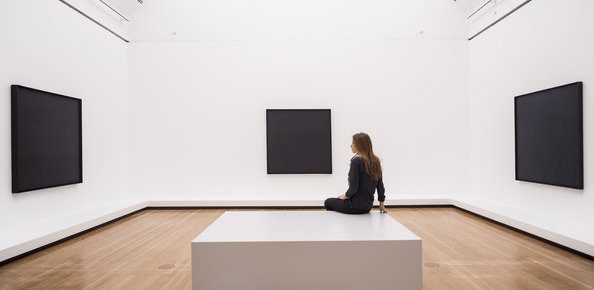 Ad Reinhardt, Black Paintings
Der Künstler als Theoretiker seiner eigenen Sprachlosigkeit
Trotz – oder gerade wegen – dieser Autonomie ist eine Flut von Selbstkommentaren und Theorien entstanden. Der moderne Künstler tritt als Denker seines eigenen Schaffens auf. Die moderne Kunst wird begleitet von Manifesten, Notizen, Theoremen, Selbstbefragungen. Und doch helfen sie uns nicht unbedingt weiter. Etwa Mondrians esoterisch-theosophische Weltanschauung erschwert eher das Verständnis seiner Werke als dass sie es klärt.
Aber vielleicht soll moderne Kunst gar nicht verstanden werden?
Die Moderne sieht sich mit einem Paradoxon konfrontiert: Das Werk, das angeblich selbst sprechen soll, wird umstellt von einem unaufhörlichen Diskurs.
Deleuze: Das pikturale Faktum und der Kampf gegen das Klischee
Gilles Deleuze gehört zu denjenigen Denkern, die dieses Paradox nicht auflösen, sondern produktiv machen. In seinen Vorlesungen „Über die Malerei“ formuliert er einen radikalen Bruch mit der Vorstellung, dass Kunst figurativ, narrativ oder repräsentativ zu sein habe. Das Sujet, das Thema des Bildes, wird zum Klischee – die eigentliche Aufgabe der Kunst liegt in der Zerstörung des Klischees.
Malerei, so Deleuze, muss das Erzählen und Illustrieren überwinden. Sie muss das Bild durch Chaos treiben, bis ein „pikturales Faktum“ entsteht – eine reine, durch keine semantische Deutung mehr vermittelbare Sichtbarkeit und Präsenz.
Der Maler beginnt seine Arbeit im schillernden Chaos, das durch die Katastrophe erst Form gewinnt. In diesem Sinn sei Michelangelos „Heilige Familie“ ein subversives Werk: Die nackten Männerfiguren im Hintergrund tun nichts. Die Szene verweigert sich jeder erzählerischen Einordnung. Doch es bleibt ein Rest. Auch das pikturale Faktum zeigt sich in einem kulturellen Raum, an einem historischen Ort, für ein Publikum mit kulturellem Vorwissen. Deleuze kann den Kontext nicht gänzlich suspendieren.
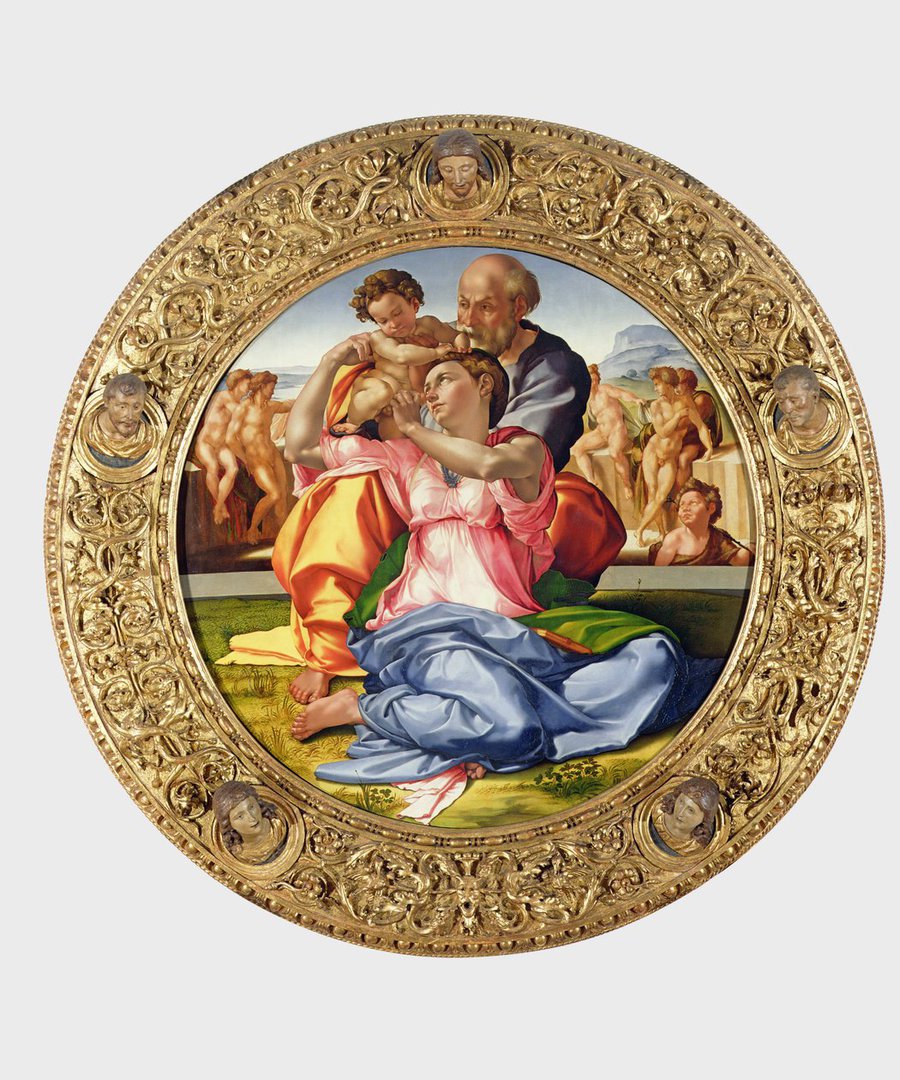 Michelangelo, Tondo Doni, 1504/5
Adorno: Rätselcharakter
Für Adorno ist ästehtische Erfahrung eine Form von Erkenntnis – nicht durch Begriff, sondern durch Form, Gestalt, Anordnung. Er fordert, das Unverständliche selbst zu verstehen, um darin den Rätselcharakter der Kunst zu reflektieren. Verstehen heißt hier nicht, etwas in bekannte Begriffe zu überführen, sondern in der Reflexion seiner Fremdheit, seiner Widerständigkeit, seiner Form des Nicht-Verstehens ein anderes Verstehen zu gewinnen.
In der "Ästhetische Theorie" beschreibt Adorno Kunstwerke als wesentlich rätselhaft – nicht im Sinne eines verborgenen Inhalts, der sich entschlüsseln ließe, sondern als eine Struktur, die sich gerade im Akt des Verstehens entzieht und darin Bedeutung erzeugt.
Der Rätselcharakter der Kunstwerke bezeichnet bei Adorno jene Spannung, dass Kunst zugleich bedeutungsvoll und unauflösbar bleibt. Kunstwerke stellen sich dar, als wollten sie „etwas sagen“, und verweigern doch die eindeutige Mitteilung. Ihr Sinn ist nicht einfach gegeben, sondern erscheint gebrochen, vermittelt, verschoben. Darin liegt ihr Erkenntnisgehalt: nicht in der Auflösung des Rätsels, sondern in seiner Austragung.
Das Unverständliche selbst zu verstehen heißt vor diesem Hintergrund, den Rätselcharakter nicht zu beseitigen, sondern ihn reflexiv auszuhalten. Das Subjekt gewinnt Erkenntnis nicht, indem es das Fremde in bekannte Begriffe überführt, sondern indem es sich der Formgesetzlichkeit des Kunstwerks aussetzt – seiner inneren Organisation, seinen Brüchen, Spannungen und Negationen. Der Rätselcharakter ist somit keine vorläufige Schwierigkeit, sondern konstitutiv.
"Signaturen" als Denkmodell jenseits binärer Ordnungen
Ein Ausweg aus der Falle von Zeichen und Bedeutung könnte in einem älteren Denkmodell liegen: der Idee der „Signaturen“, wie Michel Foucault sie in der Renaissance beschreibt. Zeichen, Bedeutung und das, was sie vermitteln, waren damals drei verschiedene Ebenen. Das Bild war kein isolierter Träger von Bedeutung, sondern eingebettet in ein „Gewimmel der Welt“, in dem es geheimnisvolle, aber lesbare Verbindungen zwischen Sichtbarem und Unsichtbarem gab.
Die Moderne hingegen favorisiert binäre Modelle: Zeichen und Bezeichnetes, Bild und Bedeutung, Form und Inhalt. Doch diese Ordnung ist für die Kunst letztlich unzureichend. Denn das Kunstwerk besitzt Eigenpräsenz – es zeigt sich, auch ohne Bedeutung im herkömmlichen Sinn.
Vielleicht liegt darin das Potential einer neuen Ästhetik: Nicht in der Rückkehr zur Allegorie oder in der Flucht in das Symbol, sondern in der Entwicklung einer Denkweise, die der Komplexität und Vielschichtigkeit von Kunst gerecht wird. Eine Rhizom-Ästhetik, ein Gewebe aus Bild, Text, Kontext und Reflexion – ohne Zentrum, ohne Anfang, ohne Ende.
(1) siehe dazu: Heribert Heere, Ad Reinhardt und die Tradition der Moderne, Frankfurt 1986
The Enigmatic Nature
Modern art operates within a paradoxical tension. On the one hand, it claims autonomy, seeking liberation from narrative, iconographic, and interpretive impositions. On the other hand—almost in the same breath—it produces an overwhelming body of self-interpretations, manifestos, reflections, and theories. Countless artists claim that there is “nothing to say” about their works—and yet the discourse continues unabated.
“When your work opens its mouth, you yourself must keep silent,” the poet-philosopher Nietzsche calls out to us. (Nietzsche, Nachlass 1883, 12)
While the autonomous artwork seeks to assert itself in self-referential self-containment, it sets in motion an interpretive process that can never be concluded. How can this tension be conceived without either imposing a meaning foreign to the artwork or ending in a nihilistic aestheticism?
The autonomous work and its unavailability
Modernism elevates the autonomous artwork to an ideal: It is no longer to be instrumentalized for religious, political, or didactic purposes. Art is to “suffice unto itself,” to be an event at rest within itself, devoid of place, time, and language.
Ad Reinhardt’s “Art-as-Art” doctrine culminates in the demand for the realization of the ever-same—the pure, empty form. (1)
This idea is strikingly reminiscent of “negative theology”: Just as the incomprehensible, transcendent God can only be conceived in terms of negations, so too should the true work of art not be defined by positive attributions. Dionysius the Areopagite, the founder of this influential negative theology in the 6th century, seems to be present here once again from the distant past.
Ad Reinhardt was also fascinated by the medieval mysticism inspired by Dionysius, e.g., by the “convergence of opposites” of Nicholas of Cusa.
The artist as theorist of his own speechlessness
Despite—or perhaps precisely because of—this autonomy, a flood of self-commentaries and theories has emerged. The modern artist presents himself as the thinker behind his own work. Modern art is accompanied by manifestos, notes, theorems, and self-questioning. And yet they do not necessarily help us. For instance, Mondrian’s esoteric-theosophical worldview tends to complicate the understanding of his works rather than clarify it.
But perhaps modern art is not meant to be understood at all?
Modernism faces a paradox: the work, which is supposed to speak for itself, is surrounded by an incessant discourse.
Deleuze: The Pictorial Fact and the Struggle Against the Cliché
Gilles Deleuze is among those thinkers who do not resolve this paradox but rather make it productive. In his lectures “On Painting,” he articulates a radical break with the notion that art must be figurative, narrative, or representational. The subject, the theme of the image, becomes a cliché—the true task of art lies in the destruction of the cliché.
Painting, according to Deleuze, must overcome narration and illustration. It must drive the image through chaos until a “pictorial fact” emerges—a pure visibility and presence no longer mediate by any semantic interpretation.
The painter begins his work in the dazzling chaos that only takes shape through catastrophe. In this sense, Michelangelo’s “Holy Family” is a subversive work: the naked male figures in the background do nothing.
The scene defies any narrative classification. Yet a residue remains. Even the pictorial fact manifests itself within a cultural space, at a historical site, for an audience with cultural prior knowledge. Deleuze cannot entirely suspend the context.
Adorno: Enigmatic Character
For Adorno, aesthetic experience is a form of cognition—not through concept, but through form, shape, and arrangement. He calls for understanding the incomprehensible itself in order to reflect on the enigmatic character of art within it. To understand here does not mean to translate something into familiar concepts, but to gain a different kind of understanding through the reflection of its strangeness, its resistance, and its form of non-understanding.
In “Aesthetic Theory,” Adorno describes works of art as essentially enigmatic—not in the sense of a hidden content that could be deciphered, but as a structure that eludes comprehension precisely in the act of understanding and thereby generates meaning.
For Adorno, the enigmatic character of works of art denotes the tension that art remains both meaningful and irreducible. Works of art present themselves as if they wanted to “say something,” yet refuse to convey a clear message. Their meaning is not simply given, but appears fragmented, mediated, and displaced. Therein lies their cognitive content: not in the resolution of the enigma, but in its unfolding.
Against this backdrop, to understand the incomprehensible itself means not to eliminate the enigmatic character, but to endure it reflexively. The subject gains insight not by translating the foreign into familiar concepts, but by exposing itself to the formal laws of the artwork—its internal organization, its breaks, tensions, and negations. The enigmatic character is thus not a temporary difficulty, but a constitutive one.
“Signatures” as a conceptual model beyond binary orders
A way out of the trap of signs and meaning might lie in an older conceptual model: the idea of “signatures,” as Michel Foucault describes it in the Renaissance. Signs, meaning, and what they convey were three distinct levels at that time. The image was not an isolated carrier of meaning, but embedded in a “swarm of the world,” in which there were mysterious yet legible connections between the visible and the invisible.
Modernity, on the other hand, favors binary models: sign and signified, image and meaning, form and content. Yet this order is ultimately insufficient for art. For the artwork possesses a presence of its own—it reveals itself, even without meaning in the conventional sense.
Perhaps therein lies the potential for a new aesthetic: not in a return to allegory or an escape into symbolism, but in the development of a way of thinking that does justice to the complexity and multi-layered nature of art. A rhizomatic aesthetic, a web of image, text, context, and reflection—without a center, without a beginning, without an end.
(1) See also: Heribert Heere, Ad Reinhardt and the Tradition of Modernism, Frankfurt 1986
 Druckversion