Das Groteske
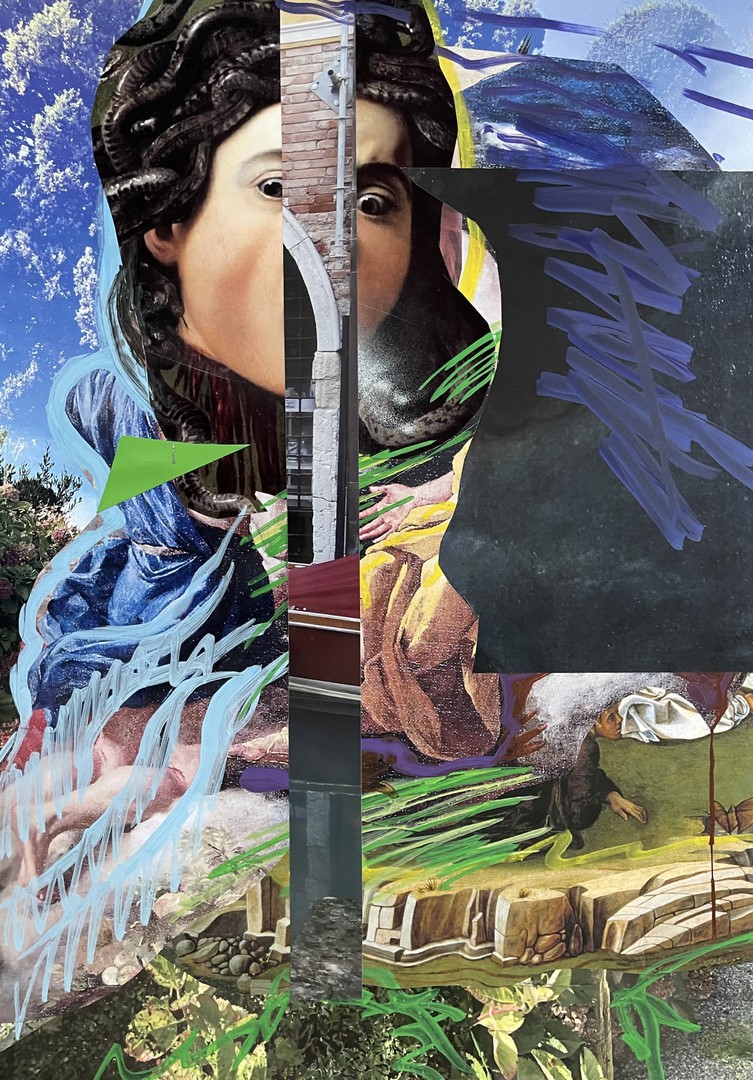 Medusa, 2022, Acryl/Collage, 100 x 70 cm
Das Groteske als Krise der Form
Die abendländische Metaphysik ist – in ihren klassischen Gestalten – auf Form, Maß, Identität und Abgrenzbarkeit ausgerichtet. Ein Ding ist, was es ist, indem es sich von anderem unterscheidet; der Mensch erscheint als in sich ruhendes, rationales Subjekt; der Körper als geordnete Gestalt; die Welt als prinzipiell intelligible Struktur. Das Groteske setzt genau hier an: Es ist kein äußerer Zusatz zu dieser Ordnung, sondern ihr innerer Störfall.
Phänomenologisch zeigt sich das Groteske als Deformation ohne vollständigen Verlust der Erkennbarkeit. Gerade darin liegt seine eigentümliche Kraft: Es zerstört die Form nicht vollständig, sondern verformt sie so, dass sie zugleich erkennbar und unhaltbar wird. In dieser Spannung – zwischen Wiedererkennen und Entgleiten – entsteht die spezifische Erfahrung des Grotesken. Es ist weder bloße Negation noch reines Chaos, sondern eine Art pathologische Klarheit: Die Ordnung erscheint, indem sie zerbricht.
Hier lässt sich mit Friedrich Nietzsche sprechen: Das Groteske gehört zur dionysischen Unterströmung der Kultur, die die apollinische Form nicht einfach negiert, sondern sie unterläuft, übersteigert, zerreißt.
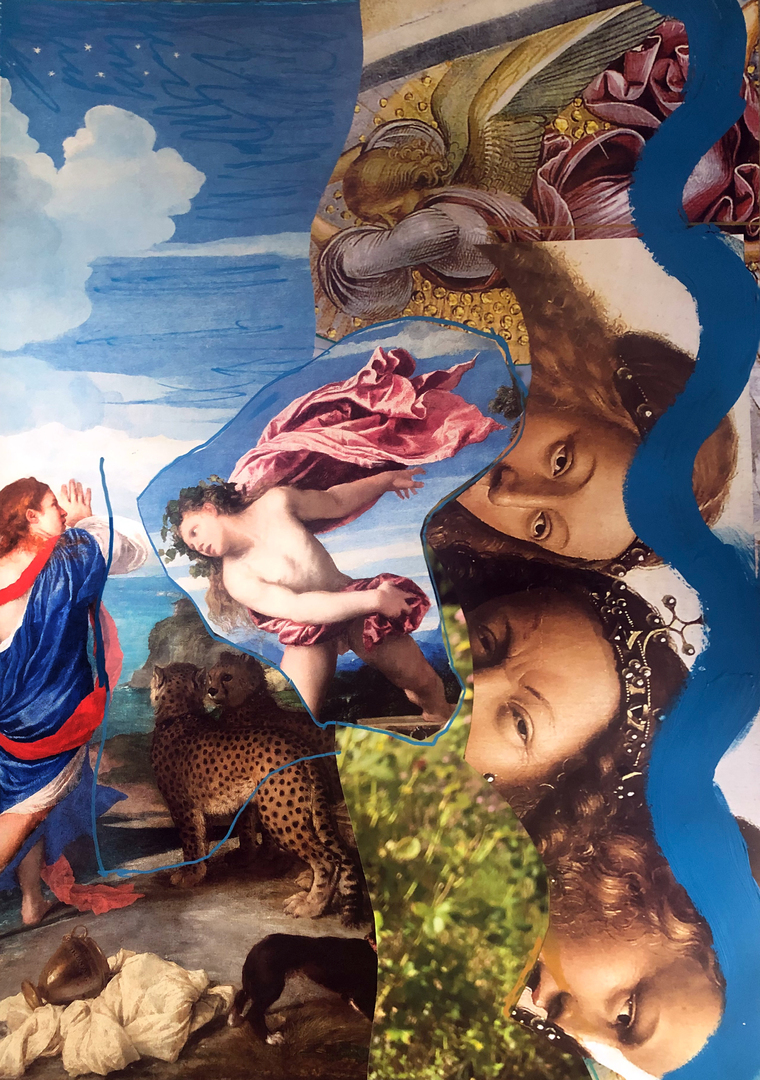 Dionysos 05, 2021, Acryl/Collage, 100 x 70 cm
Leib, Grenze und Entgrenzung
Ein privilegierter Ort des Grotesken ist der Leib. Der klassische Körper ist abgeschlossen, proportioniert, kontrolliert. Der groteske Körper hingegen ist offen, überbordend, durchlässig: Er wächst, zerfällt, verbindet sich mit anderem. In ihm wird die Grenze zwischen Innen und Außen prekär.
Diese Einsicht hat Michael Bachtin in seiner Theorie des „grotesken Körpers“ radikalisiert. [1] Der Körper erscheint hier nicht als individuelle Einheit, sondern als Prozess, als Durchgang von Stoffen, Kräften, Rhythmen. Geburt und Tod, Essen und Ausscheiden, Sexualität und Verwesung sind keine Randphänomene, sondern konstitutiv. Das Groteske entlarvt damit die kulturelle Fiktion eines geschlossenen Subjekts.
Doch diese leibliche Entgrenzung ist nicht bloß biologisch zu verstehen. Sie ist eine ontologische Geste: Das Sein selbst zeigt sich nicht als stabile Substanz, sondern als Übergang, als Vermischung, als Werden. Das Groteske ist insofern eine Erscheinungsweise von Welt, in der Identität sekundär und Prozess primär ist.
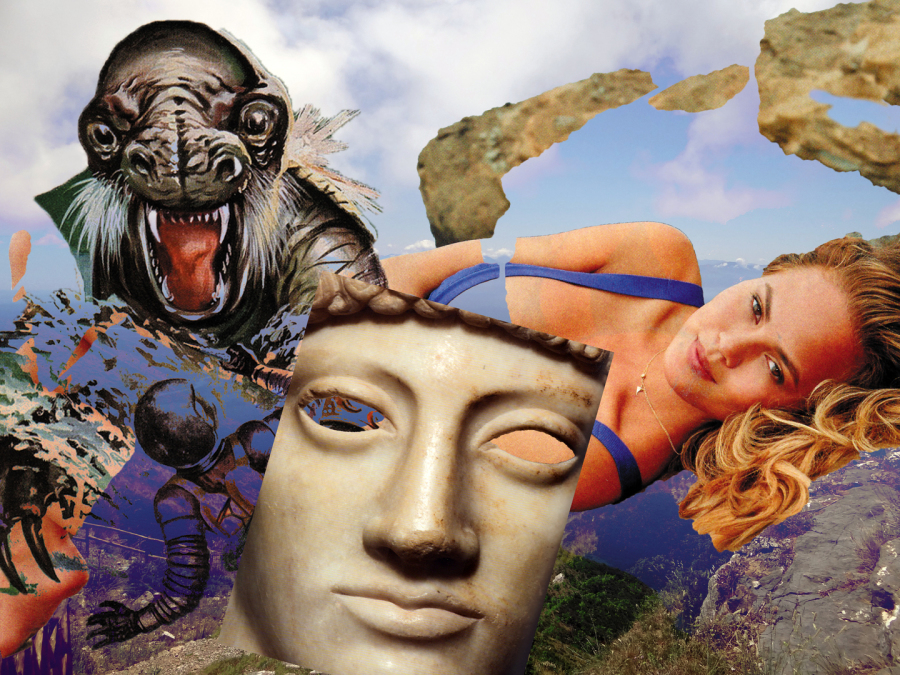 Arcadia 06, 2017, AcrylCollage, 70 x 100 cm
Das Unheimliche und die Spaltung des Subjekts
Mit der Neuzeit verschiebt sich das Groteske von der äußeren Deformation stärker in die Struktur der Subjektivität. Das Ich, das sich als Zentrum von Vernunft und Selbstgewissheit entwirft, begegnet im Grotesken seiner eigenen Auflösung.
Hier berührt sich das Groteske mit dem, was Sigmund Freud das „Unheimliche“ nennt: das ursprünglich Vertraute, das „Heimliche“ wird fremd.[2] Doch das Groteske geht darüber hinaus. Es bleibt nicht bei der Irritation des Bekannten, sondern produziert aktiv Mischungen des Unvereinbaren – Doppelgänger, Automaten, lebendige Dinge, mechanische Körper, maskenhafte Personen. Das Subjekt erkennt sich selbst nicht mehr als Einheit, sondern als Zusammenfügung heterogener Momente.
Diese Erfahrung radikalisiert sich in der Moderne. Bei Franz Kafka etwa wird die Welt nicht einfach irrational, sondern überrational und zugleich sinnlos. Verfahren, Regeln und Institutionen funktionieren – und gerade dadurch erscheinen sie grotesk. Das Groteske verschiebt sich hier von der Gestalt in die Struktur: Nicht nur Körper, sondern Ordnungen selbst werden deform.
Das Subjekt steht dann nicht mehr einem chaotischen Außen gegenüber, sondern einer Ordnung, die sich als unverständlich erweist. Das Groteske ist in dieser Perspektive die Erfahrung, dass Rationalität selbst monströs werden kann.
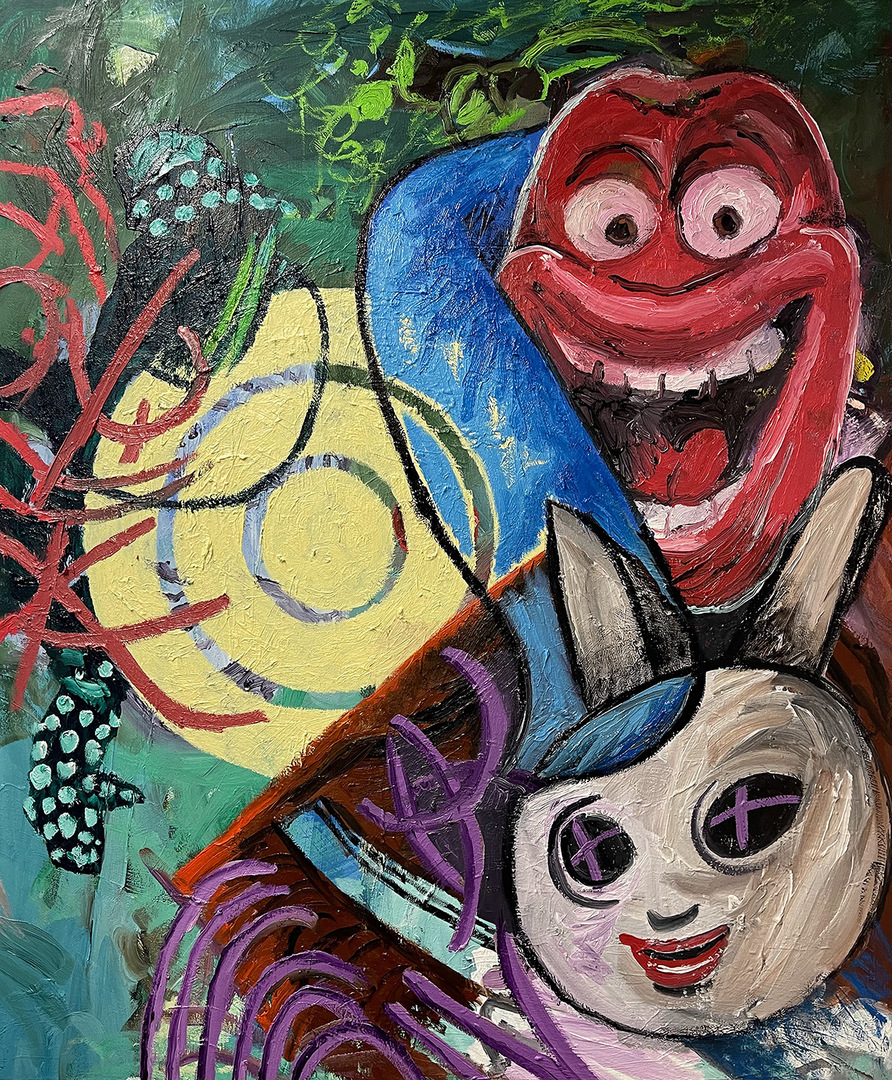 Lächeln im Chaos, 2024, Öl/Leinwand, 120 x 100 cm
Ästhetische Negativität und das Häßliche
Das Groteske ist nicht einfach ein Gegenstand unter anderen, sondern eine kritische Kategorie. Es macht sichtbar, dass jede Formbildung Ausschlüsse produziert: Das Reine definiert sich gegen das Unreine, das Schöne gegen das Hässliche, das Menschliche gegen das Tierische, das Vernünftige gegen das Triebhafte.
Das Groteske bringt diese ausgeschlossenen Momente zurück – nicht in ihrer ursprünglichen Gestalt, sondern als verzerrte, übersteigerte, oft lächerliche oder erschreckende Figuren. Es ist daher eine Form von immanenter Kritik: Es zeigt die Wahrheit der Ordnung, indem es ihre Verdrängungen exponiert.
In diesem Sinn lässt sich das Groteske im Horizont des Häßlichen lesen, wie es Theodor W. Adorno in seiner Ästhetischen Theorie ausführt.[3] Das Häßliche ist die „ästhetische“ Erscheinung dieses Nicht-Identischen, jedoch nicht in reiner Form, sondern als deformierte Rückkehr.
Es ist daher kein Zufall, dass das Groteske oft komisch wirkt. Das Lachen ist hier kein Zeichen von Harmlosigkeit, sondern eine gebrochene Reaktion: Es entlädt Spannung, ohne sie aufzulösen. Man lacht, weil die Ordnung versagt – und erschrickt zugleich über die Konsequenzen dieses Versagens.
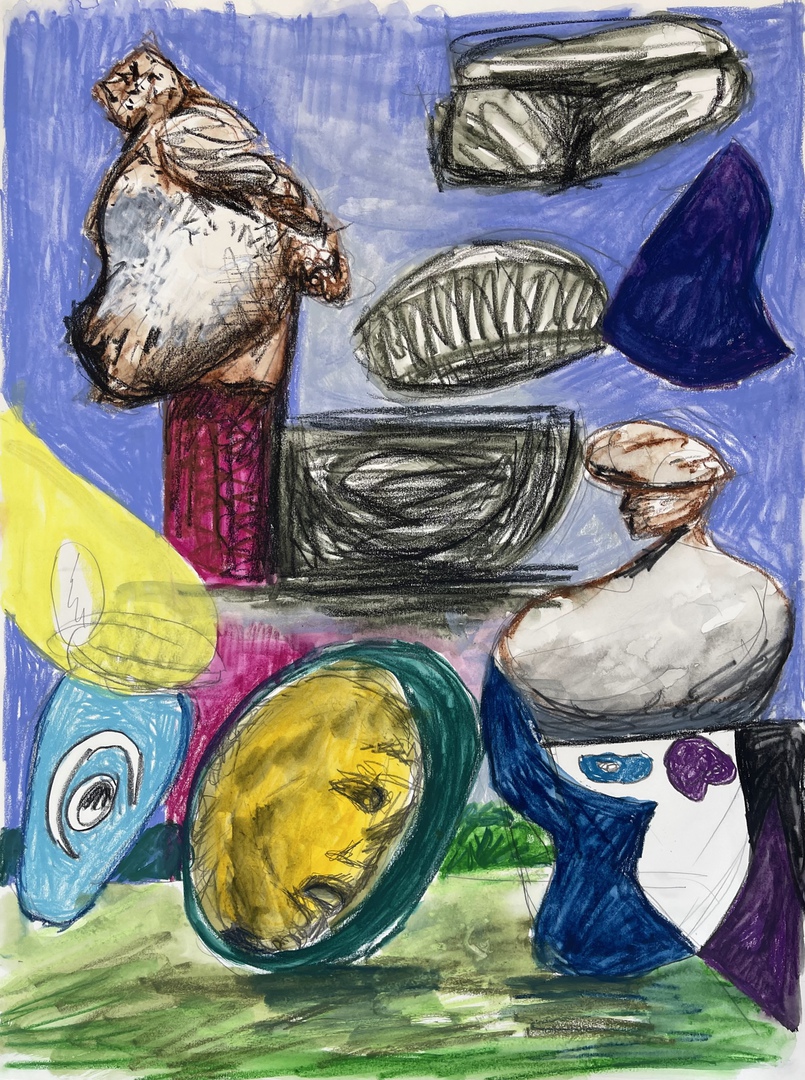 Driftende Fragmente, 2025, Aquarellkreide, 61 x 46 cm
Macht, Norm und Entmenschlichung
Das Groteske hat auch eine eminent politische Dimension. Indem es Normen sichtbar macht, kann es sie unterlaufen. Karikatur und Verzerrung entziehen der Macht ihre Selbstverständlichkeit, indem sie ihre Formen ins Lächerliche oder Monströse überführen.
Doch diese Bewegung ist ambivalent. Dieselbe Logik kann von Macht selbst genutzt werden. Wenn bestimmte Gruppen als tierisch, deformiert oder unrein dargestellt werden, wird das Groteske zum Instrument der Entmenschlichung. Es zeigt sich hier eine gefährliche Dialektik: Das, was die Ordnung kritisieren kann, kann auch ihre Gewalt verstärken.
Das Groteske lässt sich als Grenzfigur bestimmen: Es gehört weder vollständig zur Ordnung noch vollständig zum Chaos. Es ist der Punkt, an dem die Ordnung ihre eigene Instabilität zeigt.
Das Abendland hat sich über Jahrhunderte hinweg durch Ideale von Maß, Identität und Vernunft definiert. Das Groteske begleitet diese Ideale als ihr notwendiger Schatten. Es erinnert daran, dass jede Form prekär ist, jede Identität brüchig, jede Ordnung durch das bedroht, was sie ausschließt.
In diesem Sinn ist das Groteske keine Randerscheinung, sondern eine Erkenntnisform. Es zeigt das Andere der Vernunft, die Vernunft in ihrer Selbstüberschreitung. Es ist die Erfahrung, die uns insbesondere die Künstlerinnen und Künstler vermitteln, indem sie jene deformierten Bilder hervorbringen, in denen diese Ordnung zerfällt.
Das Groteske ist damit nicht nur ästhetisch, sondern ontologisch bedeutsam: Es ist die Erscheinung einer Welt, in der Identität nie vollständig mit sich selbst zusammenfällt – und in der gerade diese Nicht-Identität sichtbar, spürbar und denkbar wird.
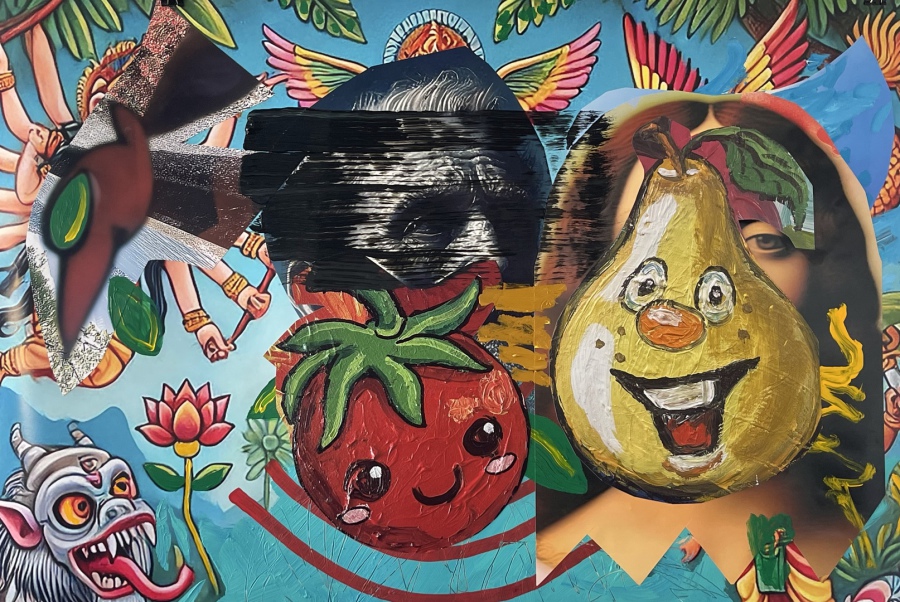 Cuties, 2026, Acryl/Collage, 70 x 100 cm
Digitale Spiegelungen
In sozialen Medien erzeugen Profile, Stories, Feeds und algorithmisch gewichtete Sichtbarkeiten ein Selbst, das sich zugleich zeigt und entzieht. Diese digitalen Spiegelungen sind keine bloßen Abbilder. Sie greifen in das Leben zurück, modulieren Wahrnehmung, Verhalten, Selbstverhältnis. Das Ich begegnet sich selbst als zirkulierende Oberfläche – erkennbar und doch instabil.
Hier liegt ein genuin groteskes Moment: Identität wird nicht negiert, sondern überformt. Sie bleibt sichtbar, aber verliert ihre Verbindlichkeit. Zwischen Inszenierung und Rückwirkung entsteht eine Spaltung, in der das Subjekt sich selbst nicht mehr eindeutig zuordnen kann. Das Vertraute kippt ins Fremde, ohne ganz unkenntlich zu werden.
Synthetische Gesichter, Stimmen und Bewegungen sind nicht einfach falsch; sie sind präzise genug, um als wirklich zu erscheinen, und zugleich instabil genug, um diese Wirklichkeit zu unterlaufen.
Das Groteske liegt hier nicht in der offenen Verzerrung, sondern in der fast gelungenen Imitation. Die Differenz zwischen Original und Kopie wird nicht aufgehoben, sondern unentscheidbar gemacht. Ein Gesicht spricht, eine Stimme bezeugt, ein Körper handelt – doch die ontologische Referenz bleibt leer. Die Form ist intakt, aber ihr Träger entzogen.
Diese Leerstelle wirkt zurück auf die Wahrnehmung selbst: Wenn jedes Bild potenziell generiert ist, verliert das Sichtbare seine Evidenz. Das Groteske zeigt sich als Krise der Glaubwürdigkeit – nicht durch Chaos, sondern durch übersteigerte Präzision.
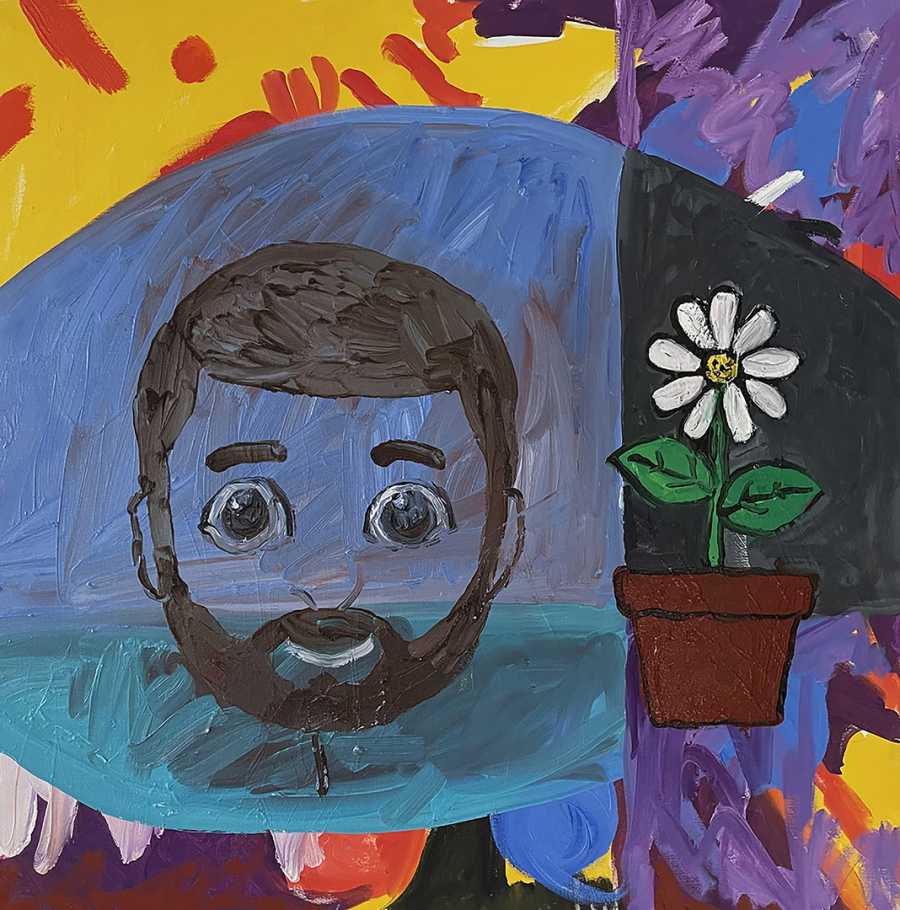 Avatar, 2023, Öl/Leinwand, 80 x 80 cm
Avatare
Im digitalen Raum tritt das Subjekt zunehmend als Avatar auf. Diese Figuren sind keine Masken im klassischen Sinn, hinter denen ein stabiles Ich verborgen liegt. Sie sind operative Instanzen, die handeln, kommunizieren, reagieren. In ihnen verteilt sich Subjektivität über verschiedene Ebenen: biologischer Leib, psychisches Erleben, technische Repräsentation.
Das groteske Moment liegt in dieser Verteilung selbst. Das Subjekt ist weder ganz präsent noch ganz ersetzt. Es existiert in Übergängen, in partiellen Verkörperungen, in synchronen und asynchronen Erscheinungen. Der Avatar ist nicht einfach „unecht“, sondern eine hybride Form, in der sich Realität und Simulation durchdringen.
Damit verschiebt sich auch die Grenze des Leibes. Der Körper wird nicht nur dargestellt, sondern erweitert, fragmentiert, rekonfiguriert. Identität erscheint als etwas, das zirkuliert, sich aktualisiert, sich vervielfältigt.
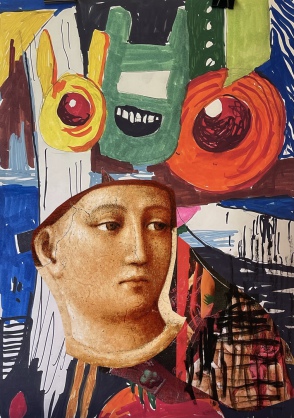 Metaphysische Kulisse, 2026, Acryl/Collage, 100 x 70 cm
Virale Übertreibung
Die Dynamik sozialer Netzwerke verstärkt das groteske Prinzip der Übersteigerung. Memes, verzerrte Bilder, ironische Brechungen und affektive Zuspitzungen zirkulieren in rasender Geschwindigkeit. Inhalte werden nicht nur geteilt, sondern transformiert, überzeichnet, entstellt und neu kontextualisiert.
Das Ergebnis ist keine bloße Unordnung, sondern eine eigentümliche Form von Klarheit: Die Mechanismen von Aufmerksamkeit, Affekt und Macht treten in ihrer Übertreibung offen hervor. Zugleich verliert das Einzelne seine Stabilität. Bedeutung entsteht situativ, flüchtig, oft widersprüchlich.
Das Lachen, das diese Formen begleitet, bleibt gebrochen. Es ist nicht einfach befreiend, sondern Ausdruck einer Spannung, die sich nicht auflöst. Man erkennt die Struktur – und erfährt zugleich ihre Unkontrollierbarkeit.
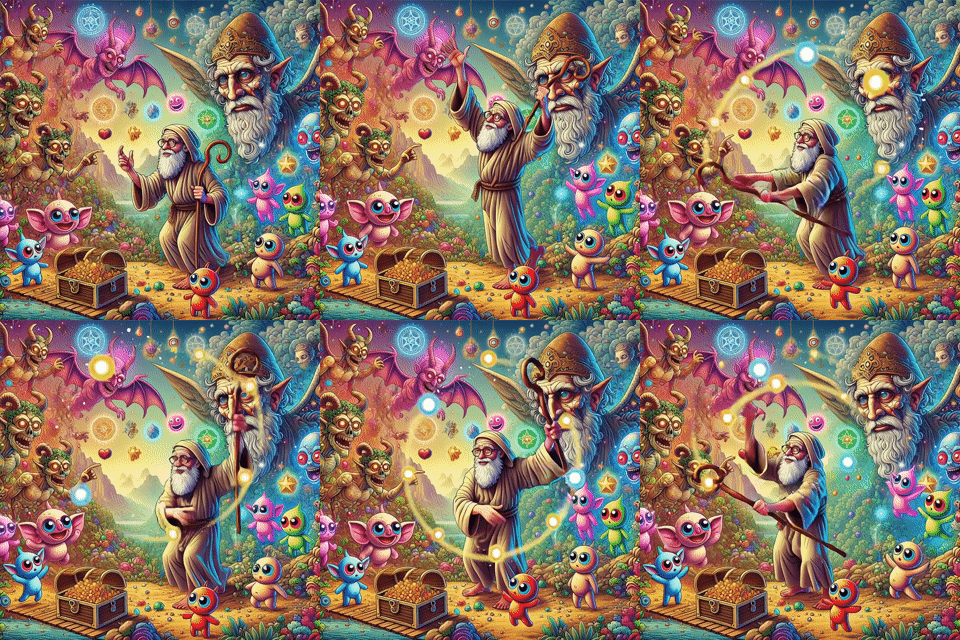 Die Versuchung des hl. Antonius, 2025, GIF
Strukturale Entfremdung
In der Verknüpfung von Plattformen, Datenökonomien und algorithmischer Steuerung erscheint das Groteske schließlich als Eigenschaft der Ordnung selbst. Systeme klassifizieren, bewerten und prognostizieren. Sie funktionieren mit hoher Effizienz – und entziehen sich zugleich dem verstehenden Zugriff der Einzelnen.
Hier kehrt die Figur der institutionellen Groteske in digitaler Gestalt wieder. Nicht die Ausnahme ist deformiert, sondern die Regel. Das Subjekt wird als Datensatz behandelt, als Muster, als Wahrscheinlichkeit. Seine Singularität bleibt formal präsent, wird aber funktional neutralisiert.
Das Groteske liegt in dieser Diskrepanz: zwischen der scheinbaren Rationalität des Systems und der Erfahrung seiner Fremdheit. Die Ordnung erscheint nicht als chaotisch, sondern als übergeordnet, präzise und zugleich unverständlich.
In der digitalen Welt zeigt sich das Groteske somit nicht mehr primär als Abweichung von der Form, sondern als deren Transformation unter Bedingungen technischer Reproduzierbarkeit und algorithmischer Vermittlung. Es ist die Erfahrung einer Wirklichkeit, in der Identität, Körper und Wahrheit nicht verschwinden, sondern in Zustände übergehen, die sie zugleich sichtbar machen und untergraben.
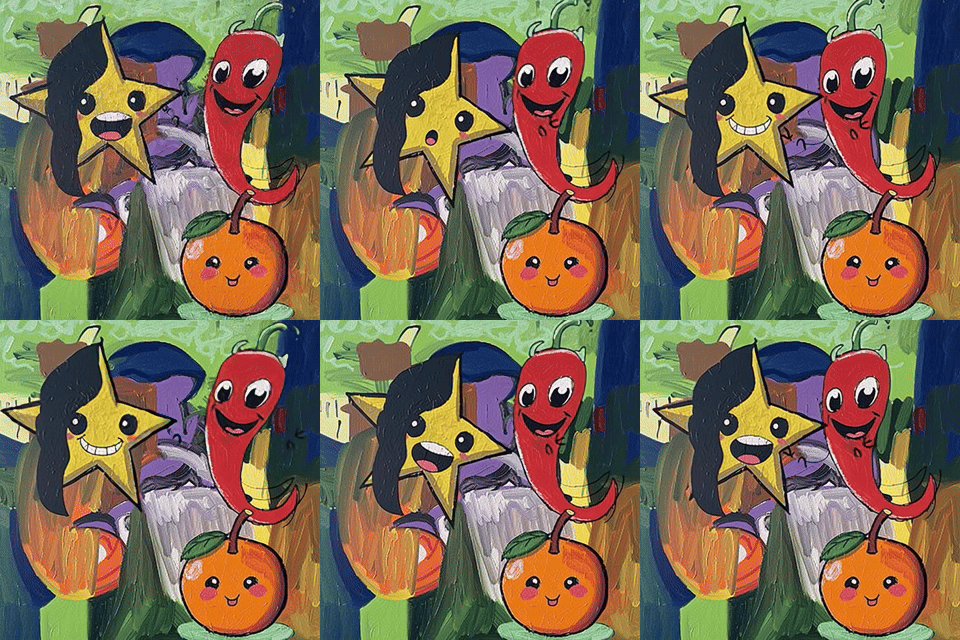 Stern und Cuties, 2026, GIF
The Grotesque
The Grotesque as a Crisis of Form
Western metaphysics—in its classical forms—is oriented toward form, proportion, identity, and demarcation. A thing is what it is by distinguishing itself from other things; the human being appears as a self-contained, rational subject; the body as an ordered form; the world as a fundamentally intelligible structure. The grotesque takes its cue precisely here: it is not an external addition to this order, but its internal disruption.
Phenomenologically, the grotesque manifests as a deformation without a complete loss of recognizability. Precisely therein lies its peculiar power: it does not completely destroy the form, but deforms it in such a way that it becomes both recognizable and untenable. In this tension—between recognition and slipping away—the specific experience of the grotesque arises. It is neither mere negation nor pure chaos, but a kind of pathological clarity: order appears by breaking apart.
Here we can echo Friedrich Nietzsche: the grotesque belongs to the Dionysian undercurrent of culture, which does not simply negate the Apollonian form, but undermines, exaggerates, and tears it apart.
Body, Boundary, and the Dissolution of Boundaries
A privileged site of the grotesque is the body. The classical body is closed, proportioned, controlled. The grotesque body, on the other hand, is open, exuberant, permeable: it grows, decays, and connects with other things. Within it, the boundary between inside and outside becomes precarious.
Michael Bakhtin radicalized this insight in his theory of the “grotesque body.” [1] Here, the body appears not as an individual unit, but as a process, as a passage of substances, forces, and rhythms. Birth and death, eating and excretion, sexuality and decay are not marginal phenomena, but constitutive. The grotesque thus exposes the cultural fiction of a closed subject.
Yet this bodily dissolution of boundaries is not to be understood merely in biological terms. It is an ontological gesture: Being itself reveals itself not as a stable substance, but as transition, as mixture, as becoming. In this respect, the grotesque is a mode of manifestation of a world in which identity is secondary and process is primary.
The Uncanny and the Schism of the Subject
With the modern era, the grotesque shifts more strongly from external deformation into the structure of subjectivity. The ego, which conceives of itself as the center of reason and self-certainty, encounters its own dissolution in the grotesque.
Here, the grotesque intersects with what Sigmund Freud calls the “uncanny”: the originally familiar, the “intimate,” becomes alien.[2] Yet the grotesque goes beyond this. It does not stop at the irritation of the familiar, but actively produces mixtures of the incompatible—doppelgängers, automatons, living things, mechanical bodies, mask-like figures. The subject no longer recognizes itself as a unity, but as an assemblage of heterogeneous moments.
This experience becomes radicalized in modernity. In Franz Kafka, for example, the world does not simply become irrational, but super-rational and at the same time meaningless. Procedures, rules, and institutions function—and precisely because of this, they appear grotesque. Here, the grotesque shifts from form to structure: not only bodies, but orders themselves become deformed.
The subject is then no longer confronted with a chaotic exterior, but with an order that proves incomprehensible. From this perspective, the grotesque is the experience that rationality itself can become monstrous.
Aesthetic Negativity and the Ugly
The grotesque is not simply an object among others, but a critical category. It reveals that every formation of form produces exclusions: the pure defines itself against the impure, the beautiful against the ugly, the human against the animal, the rational against the instinctual.
The grotesque brings these excluded moments back—not in their original form, but as distorted, exaggerated, often ridiculous or terrifying figures. It is therefore a form of immanent critique: it reveals the truth of order by exposing its repressions.
In this sense, the grotesque can be read within the horizon of the ugly, as Theodor W. Adorno explains in his Aesthetic Theory.[3] The ugly is the “aesthetic” manifestation of this non-identical, yet not in pure form, but as a deformed return.
It is therefore no coincidence that the grotesque often seems comical. Laughter here is not a sign of harmlessness, but a fractured reaction: it releases tension without resolving it. One laughs because order fails—and is simultaneously startled by the consequences of this failure.
Power, Norm, and Dehumanization
The grotesque also has an eminently political dimension. By making norms visible, it can subvert them. Caricature and distortion strip power of its self-evidence by transforming its forms into the ridiculous or the monstrous.
Yet this movement is ambivalent. The same logic can be exploited by power itself. When certain groups are depicted as animal-like, deformed, or impure, the grotesque becomes an instrument of dehumanization. A dangerous dialectic emerges here: that which can critique order can also reinforce its violence.
The grotesque can be defined as a border figure: it belongs neither entirely to order nor entirely to chaos. It is the point at which order reveals its own instability.
For centuries, the Western world has defined itself through ideals of moderation, identity, and reason. The grotesque accompanies these ideals as their necessary shadow. It reminds us that every form is precarious, every identity fragile, every order threatened by what it excludes.
In this sense, the grotesque is not a marginal phenomenon, but a form of insight. It reveals the other side of reason, reason in its self-transcendence. It is the experience that artists in particular convey to us by producing those distorted images in which this order disintegrates.
The grotesque is thus significant not only aesthetically but ontologically: it is the manifestation of a world in which identity never fully coincides with itself—and in which precisely this non-identity becomes visible, tangible, and conceivable.
Digital Reflections
On social media, profiles, stories, feeds, and algorithmically weighted visibilities create a self that simultaneously reveals and eludes itself. These digital reflections are not mere images. They reach back into life, modulating perception, behavior, and the relationship to the self. The self encounters itself as a circulating surface—recognizable yet unstable.
Herein lies a genuinely grotesque moment: identity is not negated, but reshaped. It remains visible, yet loses its binding force. A split emerges between staging and repercussion, in which the subject can no longer unambiguously identify itself. The familiar tips into the foreign without becoming entirely unrecognizable.
Synthetic faces, voices, and movements are not simply false; they are precise enough to appear real, and at the same time unstable enough to undermine that reality.
The grotesque here lies not in overt distortion, but in the nearly successful imitation. The difference between original and copy is not abolished, but rendered undecidable. A face speaks, a voice testifies, a body acts—yet the ontological reference remains empty. The form is intact, but its bearer is absent.
This void affects perception itself: when every image is potentially generated, the visible loses its evidentiary power. The grotesque reveals itself as a crisis of credibility—not through chaos, but through exaggerated precision.
Avatars
In the digital realm, the subject increasingly appears as an avatar. These figures are not masks in the classical sense, behind which a stable self lies hidden. They are operative entities that act, communicate, and react. In them, subjectivity is distributed across various levels: the biological body, psychological experience, and technical representation.
The grotesque moment lies in this distribution itself. The subject is neither fully present nor fully replaced. It exists in transitions, in partial embodiments, in synchronous and asynchronous manifestations. The avatar is not simply “fake,” but a hybrid form in which reality and simulation interpenetrate.
This also shifts the boundaries of the body. The body is not merely represented, but expanded, fragmented, reconfigured. Identity appears as something that circulates, actualizes itself, and multiplies.
Viral Exaggeration
The dynamics of social networks amplify the grotesque principle of exaggeration. Memes, distorted images, ironic refractions, and affective intensifications circulate at breakneck speed. Content is not merely shared, but transformed, exaggerated, distorted, and recontextualized.
The result is not mere disorder, but a peculiar form of clarity: the mechanisms of attention, affect, and power emerge openly in their exaggeration. At the same time, the individual loses its stability. Meaning arises situationally, fleetingly, often contradictorily.
The laughter that accompanies these forms remains fractured. It is not simply liberating, but an expression of a tension that does not resolve. One recognizes the structure—and at the same time experiences its uncontrollability.
Structural Alienation
In the interconnection of platforms, data economies, and algorithmic control, the grotesque ultimately appears as a property of order itself. Systems classify, evaluate, and predict. They function with high efficiency—and at the same time elude the understanding grasp of individuals.
Here, the figure of the institutional grotesque returns in digital form. It is not the exception that is deformed, but the rule. The subject is treated as a data set, as a pattern, as a probability. Its singularity remains formally present but is functionally neutralized.
The grotesque lies in this discrepancy: between the apparent rationality of the system and the experience of its strangeness. The order does not appear chaotic, but rather as overarching, precise, and at the same time incomprehensible.
In the digital world, the grotesque thus no longer manifests itself primarily as a deviation from form, but as its transformation under conditions of technical reproducibility and algorithmic mediation. It is the experience of a reality in which identity, body, and truth do not disappear, but transition into states that simultaneously render them visible and undermine them.
[1] Mikhail Bakhtin: The Grotesque Conception of the Body and Its Sources, in: Ibid.: Rabelais and His World: Popular Culture and Counterculture. Frankfurt 1995
[2] Sigmund Freud, The Uncanny
[3] Theodor W. Adorno, Aesthetic Theory, p. 74ff, Frankfurt 1970
 Druckversion