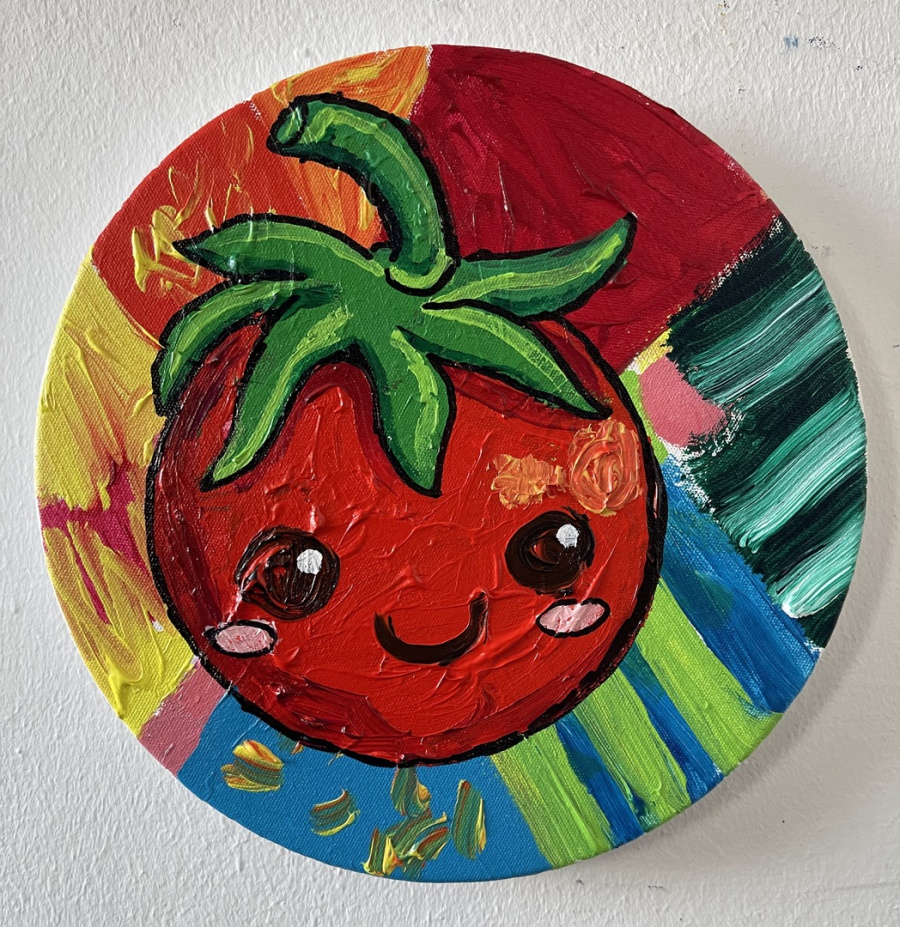
Tomato-Cutie, 2026, Acryl/Leinwand, O 30 cm
„Tomato Cutie“ erscheint wie ein Emblem: Das runde Bildformat erinnert an Buttons, Profilbilder oder App-Icons – geschlossene Systeme visueller Identität. In ihrer Mitte leuchtet die Tomate, rot und präsent, fast sphärisch aus dem Bildraum hervortretend. Die pastose Malweise verleiht ihr eine körperliche Dichte; das Rot ist nicht glatt, sondern bewegt, geschichtet, tastbar. Licht bricht sich in den Spuren des Pinsels und macht aus der Oberfläche ein Relief.
Das Grün ihrer Blätter, von dunklen Konturen gefasst, krönt die Frucht wie ein lebendiger Kopfschmuck. Die Linien sind klar, fast comicartig, und setzen einen bewussten Kontrast zur expressiven Hintergrundmalerei. Figur und Grund stehen in einem Spannungsverhältnis: präzise Umrisslinie hier, gestische Farbflächen dort.
Cutie-Ästhetik und digitale Gegenwart
Mit ihren großen, glänzenden Augen, den rosigen Wangen und dem kleinen, geschwungenen Lächeln bedient die Tomate eine Bildsprache, die aus unserer digitalen Kultur vertraut ist. Niedlichkeit fungiert hier nicht nur als dekoratives Element, sondern als Kommunikationsform – als universelle Geste der Zugänglichkeit. In einer Gegenwart, in der visuelle Identitäten oft in runden Icons zirkulieren und Produkte durch sympathische Maskottchen eine emotionale Aufladung erfahren, erscheint diese Tomate wie ein Hybrid aus Naturform und Avatar.
Doch das Bild bleibt nicht im rein Illustrativen stehen. Die Übersetzung der „Cutie“-Ästhetik in Malerei verändert ihre Qualität. Was im Digitalen glatt und immateriell wäre, wird in der pastosen Malerei schwer, greifbar, farbsatt. Die Affirmation der Niedlichkeit ist also keine bloße Reproduktion, sondern eine Transformation: Das Motiv wird durch die Materialität der Farbe verlangsamt, intensiviert, vielleicht auch subtil gebrochen. Man könnte mit Walter Benjamin sagen, die digitale triviale Immaterialität wird im Original-Gemälde "auratisch".
Pop-Surrealistische Verschiebung
In dieser Spannung entfaltet sich eine Form des Pop-Surrealismus. Eine gewöhnliche Tomate erhält ein Gesicht – nicht naturalistisch, sondern ikonografisch überhöht. Sie ist zugleich vertraut und befremdlich. Ihre Augen wirken freundlich, fast beseelt; doch gerade diese Vermenschlichung verschiebt die Wahrnehmung ins Surreale. Die Frucht schaut zurück.
Der Hintergrund verstärkt diesen Eindruck. Er ist kein realistischer Raum, sondern ein farbliches Kaleidoskop aus Gelb, Rot, Blau und Grün, das sich segmentartig um die Figur legt. Die Farbfelder scheinen aus unterschiedlichen Bildwelten zu stammen, als hätten sich Fragmente eines digitalen Feeds in malerische Gesten übersetzt. Diese visuelle Vielstimmigkeit erzeugt eine traumartige Bühne, auf der die Tomate zugleich Produkt, Figur und Fantasiewesen ist.
Zwischen Affirmation und Spiel
„Tomato Cutie“ lässt sich daher weniger als konsumkritisches Statement denn als spielerische Reflexion lesen. Die Bildwelt der Warenästhetik – ihre Freude am Glanz, am Charme, an der Überzeichnung – wird nicht einfach entlarvt, sondern lustvoll aufgegriffen. Die Malerei feiert die Farbe, die Oberfläche, das Strahlen. Gleichzeitig verschiebt sie die vertraute Ästhetik in einen Bereich, in dem das Alltägliche leicht ins Märchenhafte kippt.
Die Tomate ist Objekt und Subjekt zugleich: Frucht und Figur, Produkt und Persönlichkeit. Ihr Lächeln ist offen, nicht ironisch gebrochen – doch in der Intensität der Farben und der dichten Materialität liegt eine bewusste Übersteigerung. So entsteht ein Bild, das die Logik der „Cuties“ unserer Zeit nicht negiert, sondern in ein malerisches Ereignis überführt: greifbar, leuchtend, ein wenig traumhaft.
„Tomato Cutie“ wird so zur Ikone einer Gegenwart, in der Pop, Surrealität und Warenästhetik nicht Gegensätze sind, sondern ineinanderfließen.
Tomato-Cutie, 2026, acrylic on canvas, 30 cm in diameter
“Tomato Cutie” appears like an emblem: the round format is reminiscent of buttons, profile pictures, or app icons—closed systems of visual identity. At its center, the tomato glows, red and commanding, emerging from the pictorial space in an almost spherical form. The impasto technique lends it a physical density; the red is not smooth, but dynamic, layered, and tactile. Light refracts in the brushstrokes, transforming the surface into a relief.
The green of its leaves, framed by dark contours, crowns the fruit like a living headdress. The lines are clear, almost comic-like, and create a deliberate contrast to the expressive background painting. Figure and ground exist in a tension: precise outlines here, gestural areas of color there.
Cute Aesthetics and the Digital Present
With its large, shiny eyes, rosy cheeks, and small, curved smile, the tomato employs a visual language familiar from our digital culture. Cuteness functions here not merely as a decorative element, but as a form of communication—as a universal gesture of accessibility. In a present where visual identities often circulate as round icons and products are imbued with emotional charge through likable mascots, this tomato appears as a hybrid of natural form and avatar.
Yet the image does not remain purely illustrative. The translation of the “Cutie” aesthetic into painting alters its quality. What would be smooth and immaterial in the digital realm becomes heavy, tangible, and richly colored in the impasto painting. The affirmation of cuteness is thus not a mere reproduction, but a transformation: the motif is slowed down, intensified, and perhaps subtly disrupted by the materiality of the paint. One could say, with Walter Benjamin, that the digital’s trivial immateriality becomes “auratic” in the original painting.
Pop-Surrealist Shift
In this tension, a form of Pop Surrealism unfolds. An ordinary tomato is given a face—not naturalistic, but iconographically exaggerated. It is at once familiar and alienating. Its eyes appear friendly, almost animated; yet it is precisely this humanization that shifts perception into the surreal. The fruit looks back.
The background reinforces this impression. It is not a realistic space, but a chromatic kaleidoscope of yellow, red, blue, and green that wraps around the figure in segments. The color fields seem to originate from different visual worlds, as if fragments of a digital feed had been translated into painterly gestures. This visual polyphony creates a dreamlike stage on which the tomato is simultaneously a product, a figure, and a fantasy creature.
Between Affirmation and Play
“Tomato Cutie” can therefore be read less as a statement critical of consumerism than as a playful reflection. The visual world of commodity aesthetics—its delight in gloss, charm, and exaggeration—is not simply exposed, but joyfully embraced. The painting celebrates color, surface, and radiance. At the same time, it shifts the familiar aesthetic into a realm where the everyday easily tips into the fairy-tale-like.
The tomato is both object and subject: fruit and figure, product and personality. Its smile is open, not ironically wry—yet in the intensity of the colors and the dense materiality lies a deliberate exaggeration. Thus an image emerges that does not negate the logic of the “cuties” of our time, but transforms it into a painterly event: tangible, luminous, a little dreamlike.
“Tomato Cutie” thus becomes an icon of a present in which pop, surrealism, and commodity aesthetics are not opposites, but flow into one another.
 Druckversion