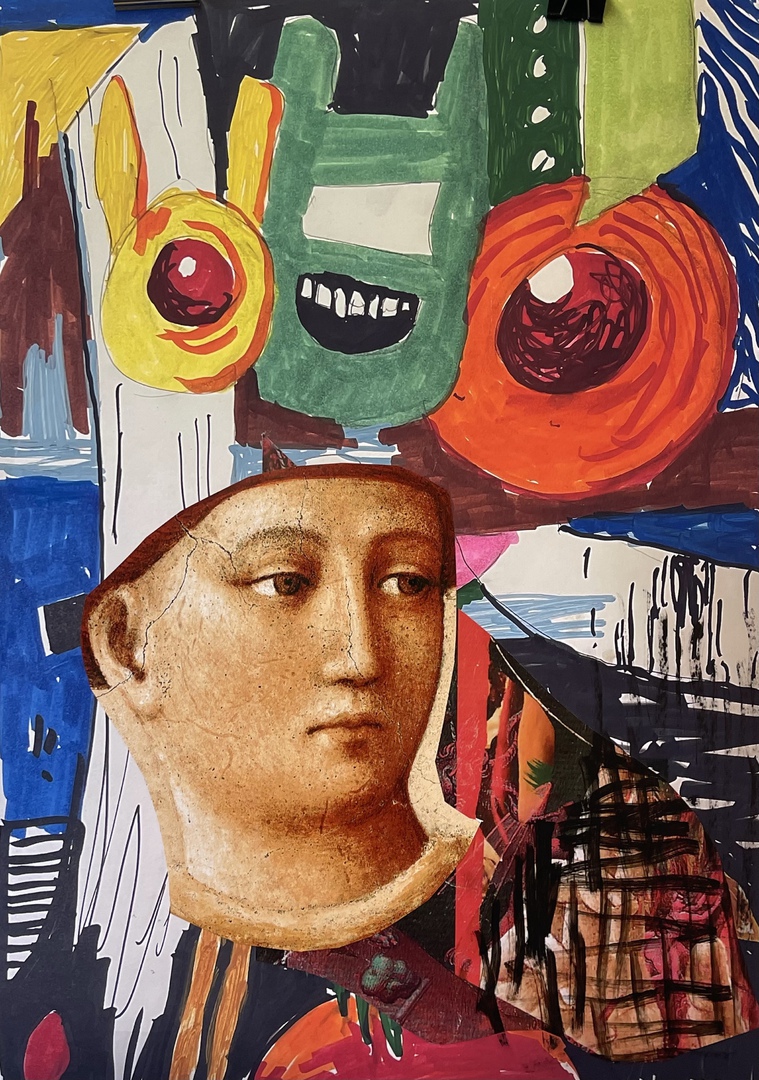
Metaphysische Kulisse, 2026, Acryl/Collage, 100 x 70 cm
Die „Metaphysische Kulisse“ entfaltet sich wie ein widersprüchlicher Denkraum, in dem Bildfragmente nicht bloß nebeneinanderstehen, sondern sich gegenseitig
kommentieren, überlagern und unterlaufen. Es ist keine Szene im herkömmlichen Sinn, sondern eher ein Zustand—eine visuelle Syntax aus Versatzstücken, die das Sehen selbst befragt.
Im Zentrum ruht ein fragmentierter Kopf aus einem Fresko von Masolino/Masaccio in der Brancacci-Kapelle in Florenz, dessen materielle Patina von Zeit, Rissen und einer stillen, fast resignativen Würde durchzogen ist. Der Blick dieses Kopfes ist seitlich gerichtet, als wolle er sich dem unmittelbaren Zugriff entziehen; er verweigert die Frontalsicht und damit die klare Lesbarkeit. Seine Präsenz wirkt schwer, erdgebunden, beinahe archäologisch—ein Überrest aus einer anderen Ordnung von Bedeutung. Doch diese Ruhe ist prekär: Der Kopf ist abgeschnitten, aus seinem ursprünglichen Kontext herausgelöst und in eine Umgebung versetzt, die ihn nicht trägt, sondern stört.
Masken
Über ihm drängt sich eine Zone greller Farbigkeit und eruptiver Gestik. Zwei kreisförmige Gebilde, eines in vibrierendem Gelb, das andere in einem aggressiven Rot,
erwecken den Eindruck eines grotesken Hutes.
Zwischen ihnen steht eine grüne, maskenhafte Form, deren rechteckige Augenhöhlen und angedeutete Zahnreihe ein Lächeln suggerieren, das jedoch nicht freundlich, sondern mechanisch, beinahe entleert erscheint. Diese obere Bildzone wirkt wie eine Karikatur von Wahrnehmung—Sehen ohne Subjekt, Ausdruck ohne Innerlichkeit.
Hier kommt Friedrich Nietzsche ins Spiel mit seiner These, dass Denken bereits Inszenierung ist. Nicht nur die Maske ist theatral—auch das vermeintlich authentische Gesicht ist Rolle, Ausdrucksgeste, eine Form von Bühnenrede. In dieser Collage tritt das Gesicht doppelt auf: als antikes Relikt individueller Tiefe und als farbige, zirkulierende Oberfläche ohne Inneres. Nietzsche hätte darin keine bloße Krise gesehen, sondern eine Enthüllung: dass das Subjekt selbst ein Schauspiel ist, ein Effekt von Perspektiven, von Kräften, die sich darstellen.
Theater des Denkens
Nietzsche scheint das Denken selbst als Bühne zu entlarven, als Maskenspiel, als Rollenwechsel, als ein fortwährendes Sich-Inszenieren. Der Denker respektive Künstler
tritt auf—als Possenreißer, als Hanswurst, als Tänzer über Abgründen, aber ebenso als Caesar, als Gesetzgeber, als Erlöserfigur. Diese Figuren sind keine stabilen Identitäten, sondern Masken, die das
Denken und erst recht die Kunst trägt, um sich überhaupt artikulieren zu können.
Die Collage scheint diese Einsicht visuell zu wiederholen: Der klassische Kopf wird nicht zerstört, sondern in ein Spiel der Masken hineingezogen. Über ihm entsteht eine Art absurdes Theater, in dem die Physiognomie sich auflöst in Zirkularität, Farbe, Rhythmus.
Karneval der Physis
Nietzsches Blick richtet sich gegen die Dekadenz einer Kultur, die den Körper mit Bedeutung überlädt, ihn moralisch, religiös und rational fixiert. Dagegen setzt er jene
Räume, in denen die Physis sich befreit: den Zirkus, die Commedia dell’arte, den Karneval, die mittelalterlichen Narrenfeste. Dort wird der Körper nicht interpretiert, sondern erprobt; er wird nicht
gedeutet, sondern gespielt.
In der Collage kehrt diese Dimension als eruptive Farbzone wieder. Die kreisenden „Augen“ und die maskenhafte Fratze wirken wie Figuren eines anarchischen Theaters—halb komisch, halb unheimlich. Sie gehören keiner festen Ordnung an, sondern erinnern an jene improvisierten, körperlichen Ausdrucksformen, in denen Identität suspendiert wird. Der Körper wird hier nicht Träger von Sinn, sondern Quelle von Energie, von Rhythmus, von ungebändigter Präsenz.
Übermalung
Im rechten unteren Bereich verdichtet sich das Bild erneut, diesmal durch eine dunkle, lineare Übermalung. Schwarze, hastig gesetzte Striche durchkreuzen eine weitere
collageartige Einfügung—eine Andeutung von Architektur oder Innenraum. Diese Geste wirkt wie ein Gegenakt zur Inszenierung: ein Versuch, das Spiel zu unterbrechen, es zu negieren oder zu
überdecken.
Doch auch diese Negation bleibt theatral. Sie ist keine stille Auslöschung, sondern eine sichtbare, fast aggressive Geste—ein Akt auf der Bühne der Bildfläche. Nietzsche würde vielleicht sagen: Selbst der Widerstand gegen das Schauspiel ist noch Teil des Schauspiels.
Der Hintergrund erscheint als Bühne ohne Tiefe, als instabile Kulisse aus Linien und Farbflächen. Nichts ist hier dauerhaft, alles scheint verschiebbar, provisorisch.
Gerade darin liegt jedoch die eigentliche Konsequenz dieser „metaphysischen“ Anordnung: Die Metaphysik selbst wird zur Kulisse—zu etwas Gemachtem, Arrangiertem, Spielbarem.
Kunst als visuelle Philosophie
So entfaltet sich die Collage als eine Art visuelle Philosophie im Sinne Nietzsches: nicht als System, sondern als Dramaturgie von Kräften, Masken und Perspektiven. Der Kopf blickt—doch er blickt nicht mehr aus einer gesicherten Identität heraus. Er ist bereits Teil des Spiels geworden, eingespannt zwischen Erinnerung und Maskerade, zwischen Schwere und Zirkulation.
Die Metaphysische Kulisse zeigt damit nicht den Verlust von Wahrheit, sondern ihre Verwandlung: Wahrheit als Aufführung, als körperlicher Vollzug, als Szene. Und der Denker—gleichgültig ob als Narr oder als Erlöser—tritt immer schon auf einer Bühne auf, die er nicht verlässt, sondern nur anders beleuchtet.
Metaphysical Backdrop, 2026, acrylic/collage, 100 x 70 cm
The “Metaphysical Backdrop” unfolds like a contradictory space of thought, in which fragments of images do not merely stand side by side, but comment on, overlap, and subvert one another. It is not a scene in the conventional sense, but rather a state—a visual syntax of set pieces that questions the act of seeing itself.
At the center rests a fragmented head from a fresco by Masolino/Masaccio in the Brancacci Chapel in Florence, whose material patina is permeated by time, cracks, and a quiet, almost resigned dignity. The gaze of this head is directed sideways, as if it were trying to elude immediate access; it refuses the frontal view and thus clear legibility. Its presence feels heavy, earthbound, almost archaeological—a remnant from another order of meaning. Yet this calm is precarious: the head is severed, removed from its original context and placed in an environment that does not support it but disturbs it.
Masks
Above it, a zone of garish color and eruptive gesture intrudes. Two circular forms, one in vibrant yellow, the other in an aggressive red, evoke the impression of a grotesque hat.
Between them stands a green, mask-like form whose rectangular eye sockets and hinted-at row of teeth suggest a smile that appears not friendly, but mechanical, almost hollow. This upper zone of the image seems like a caricature of perception—seeing without a subject, expression without inner life.
This is where Friedrich Nietzsche comes into play with his thesis that thinking is already a performance. Not only is the mask theatrical—the supposedly authentic face, too, is a role, an expressive gesture, a form of stage speech. In this collage, the face appears in two guises: as an ancient relic of individual depth and as a colorful, circulating surface without an interior. Nietzsche would not have seen this as a mere crisis, but as a revelation: that the subject itself is a spectacle, an effect of perspectives, of forces that present themselves.
Theater of Thought
Nietzsche seems to expose thought itself as a stage, as a masquerade, as a shifting of roles, as a continuous self-staging. The thinker or artist takes the stage—as a buffoon, as a clown, as a dancer over abysses, but also as Caesar, as a lawgiver, as a figure of salvation. These figures are not stable identities, but masks that thought—and art even more so—wears in order to articulate itself at all.
The collage seems to visually reiterate this insight: The classical head is not destroyed, but drawn into a play of masks. Above it, a kind of absurd theater emerges, in which physiognomy dissolves into circularity, color, and rhythm.
Carnival of the Physical
Nietzsche’s gaze is directed against the decadence of a culture that overloads the body with meaning, fixing it morally, religiously, and rationally. In contrast, he sets forth those spaces in which the physical is liberated: the circus, the Commedia dell’arte, the carnival, the medieval festivals of fools. There, the body is not interpreted but tested; it is not interpreted but played.
In the collage, this dimension returns as an eruptive zone of color.
The circling “eyes” and the mask-like grimace appear like figures from an anarchic theater—half comical, half eerie. They do not belong to any fixed order, but rather evoke those improvised, physical forms of expression in which identity is suspended. Here, the body is not a bearer of meaning, but a source of energy, of rhythm, of untamed presence.
Overpainting
In the lower right section, the image condenses once more, this time through a dark, linear overpainting. Black, hastily applied strokes crisscross another collage-like insertion—a hint of architecture or interior space. This gesture appears as a counter-act to the staging: an attempt to interrupt the play, to negate or cover it up.
Yet even this negation remains theatrical. It is not a silent erasure, but a visible, almost aggressive gesture—an act on the stage of the picture plane. Nietzsche might say: Even resistance to the spectacle is still part of the spectacle.
The background appears as a stage without depth, as an unstable backdrop of lines and patches of color. Nothing here is permanent; everything seems shiftable, provisional. Yet it is precisely in this that the true consequence of this “metaphysical” arrangement lies: metaphysics itself becomes a backdrop—something made, arranged, and performable.
Art as Visual Philosophy
Thus the collage unfolds as a kind of visual philosophy in Nietzsche’s sense: not as a system, but as a dramaturgy of forces, masks, and perspectives. The head gazes—yet it no longer gazes from within a secure identity. It has already become part of the play, caught between memory and masquerade, between heaviness and circulation.
The Metaphysical Backdrop thus does not depict the loss of truth, but its transformation: truth as performance, as physical enactment, as scene. And the thinker—whether as a fool or as a savior—always appears on a stage that he does not leave, but merely illuminates differently.
 Druckversion