Versuchung des hl. Antonius,
2025, Acryl/Photocollage, 70 x 100 cm
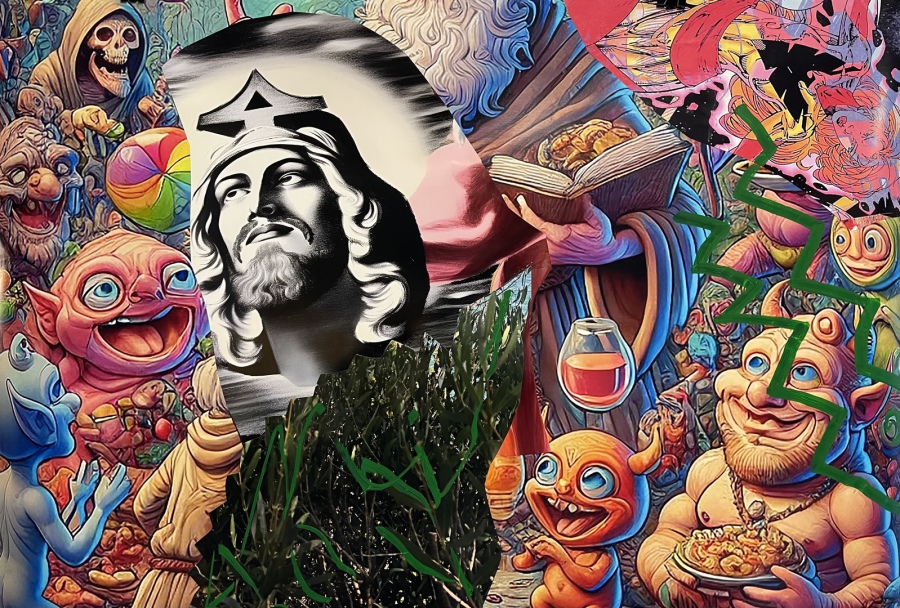
Die übermalte Fotocollage erscheint wie ein eruptives Tableau jenes „wunderbaren Vorrats an Gewaltsamkeiten, Phantasmagorien, Wahnbildern und Alpträumen mit den Zügen einer Posse “, die Michel Foucault im Nachwort zu Flauberts Versuchung des heiligen Antonius beschreibt (1): ein Ort, an dem sich nicht eine Versuchung, sondern alle Versuchungen zugleich einstellen, ohne Zentrum, ohne Hierarchie, ohne endgültige Wahrheit. Was hier sichtbar wird, ist ein Dispositiv des Sehens, in dem sich Heiligkeit, Groteske, Askese, Begehren und Textualität unaufhörlich ineinander vernetzen.
Ikonik
Im Zentrum steht das ikonische Antlitz eines hl. Antonius, schwarz-weiß, plakativ, wie aus einem Siebdruck oder einer Andachtsgrafik herausgeschnitten. Dieses Antlitz ist nicht eingebettet, sondern aufgesetzt, wie ein Gedanke, der sich dem Bild aufzwingt. Über dem Haupt schwebt ein Pfeil, der zugleich Richtung, Befehl und Diagramm ist: eine Markierung der Transzendenz, aber auch ein Zeichen jener diskursiven Gewalt, von der Foucault spricht, wenn er beschreibt, wie Bilder, Texte und Visionen den hl. Antonius nicht erlösen, sondern belagern. Der Heilige erscheint hier als Figur innerhalb eines unendlichen Archivs religiöser Imagination.
Phantasma als Genussmaschine
Um dieses Zentrum herum wuchert eine infernalisch-fröhliche Welt: groteske Wesen mit übergroßen Augen, lachenden Mündern, Essensschüsseln, Weingläsern. Sie erinnern an Dämonen, aber auch an Karikaturen des Konsums, an Maskottchen einer heidnischen Pop-Hölle. Die Versuchung ist nicht mehr das Andere des Heiligen, sondern dessen Spiegelbild, hervorgebracht aus derselben Imagination.
Mit Žižek ließe sich präzisieren: Diese Figuren sind keine bloßen Illusionen, sondern Phantasmen im strengen psychoanalytischen Sinn – Szenarien, die den Genuss organisieren, der dem Subjekt sonst unerträglich wäre. In „Die Pest der Phantasmen“(2) beschreibt Žižek das Phantasma nicht als Täuschung, sondern als notwendige Bühne, auf der Begehren überhaupt erst eine Form erhält. Die Dämonen dieser Collage verführen nicht, indem sie etwas verbergen, sondern indem sie zu viel zeigen: den nackten Genuss, eine obszöne Vitalität, das grausame Glück am Zuviel.
So blicken sie uns an, nicht als Verführer von außen, sondern als Agenten unseres eigenen Begehrens. Ihre Fröhlichkeit ist nicht unschuldig; sie markiert jenen Punkt, an dem das Subjekt sich selbst beim Genießen zusieht.
Das Buch
Bemerkenswert ist auch das Motiv des Buches in den Händen einer sonst unsichtbaren Figur am rechten Bildrand: ein offenes Buch, aus dem nicht Sinn, sondern Materie quillt. Das ist nicht das Buch des Lebens, aus dem noch lesen könnte. Hier verdichtet sich Foucaults Gedanke, dass Flauberts „Versuchung des hl. Antonius“ kein moralischer Text, sondern eine "Archäologie des Wissens" ist.
Verlust der Illusion
Die Collage ist keine Darstellung einer Versuchung, sondern deren Struktur. Sie zeigt, was Foucault an Flaubert fasziniert: die Unmöglichkeit, zwischen Vision und Halluzination, Wahrheit und Trugbild, Heiligkeit und Obszönität zu unterscheiden. Alles ist sichtbar, alles ist gleichzeitig – und genau darin liegt die Qual.
Žižeks Kritik setzt hier schärfer an: Die postmoderne Situation ist nicht durch den Verlust der Illusion gekennzeichnet, da wir wissen, dass es Phantasmen sind – und funktionieren dennoch durch sie hindurch.
Der Pfeil über dem Haupt verweist damit nicht auf Transzendenz, sondern auf das, was Žižek den leeren Ort des Begehrens nennt: ein Signifikant, der gerade durch seine Leere mobilisiert. Die Versuchung besteht nicht darin, an das Bild zu glauben, sondern darin, sich vom Bild organisieren zu lassen, ohne an es glauben zu müssen.
Das Subjekt im Phantasma
So wird diese übermalte Fotocollage zu einer zeitgenössischen Versuchung des heiligen Antonius: nicht asketisch, sondern exzessiv; nicht narrativ, sondern simultan; nicht religiös im engeren Sinn. Sie vermittelt den Betrachtern in jene Position, nicht derjenige zu sein, der sieht, sondern derjenige, durch den hindurch gesehen wird.
Das Bild verlangt keine Identifikation, sondern Komplizenschaft. Es entlarvt nicht die Phantasmen, sondern zeigt ihre Unausweichlichkeit. Gerade darin liegt die „Pest“, von der Žižek spricht: Phantasmen sind nicht pathologisch, weil sie falsch sind, sondern weil sie funktionieren – selbst dort, wo ihre Künstlichkeit offen zutage liegt.
Die Collage bietet keine Befreiung durch Aufklärung. Sie ist keine Kritik der Phantasmen, sondern eine Kritik im Phantasma: ein Bild, das zeigt, wie sehr selbst der Versuch, sich zu distanzieren, bereits Teil der Szene ist.
So ergibt sich eine doppelte Perspektive:
– als Archiv der diskursiven Erscheinungen,
– als Maschine des Genießens, die dieses Archiv bewohnbar macht.
Die übermalte Fotocollage ist beides zugleich: ein chaotisches Museum der Zeichen und eine intime Bühne des Begehrens. Sie zeigt, dass die Versuchung des heiligen Antonius nicht vergangen ist – sie hat nur ihre Form gewechselt. Nicht mehr Dämonen flüstern dem Subjekt zu, sondern Bilder.
Antonius als imaginäres Künstlerporträt
In dieser erweiterten Perspektive lässt sich die Versuchung des heiligen Antonius – und mit ihr auch diese übermalte Fotocollage – auch als ein imaginäres Porträt des Künstlers lesen, verstanden nicht als historisch begrenzte Figur der Moderne oder Postmoderne, sondern als eine transhistorische Gestalt. Theologisch betrachtet könnte Antonius in der Tradition der negativen Theologie stehen: Gott erscheint nicht als tröstende Präsenz, sondern als Abwesenheit, als Schweigen, von Bildern, Stimmen und Visionen überflutet. Diese Überfülle ist vielleicht kein Zeichen des Glaubensverlusts, sondern vielmehr eine radikale Form des Glaubens. In diesem Sinn ist Antonius eine Art Medium, in dem sich Erscheinungen sammeln. Die negative Theologie muss nicht nur im Nichts ausharren, sondern kann sich auch in der Überfülle manifestieren.
Der Künstler erscheint hier als Erfinder und als kreativer Verwalter eines Bildüberschusses, der weit in unsere Vergangenheit zurück reicht. Die in der Collage sichtbaren Überformungen – das rohe Grün, die heterogenen Stilregister, die ikonischen Versatzstücke – markieren diese Lage.
Literarisch schließlich – und hier schließt sich der Kreis zu Flaubert – ist Antonius auch ein Porträt des Autors. Flauberts lebenslange Arbeit an der Versuchung gleicht selbst einer asketischen Praxis: ein obsessives Durchspielen von Mythen, Wissenschaften, Religionen und Trugbildern. Schreiben wird hier nicht zur Artikulation einer Position, sondern zur Exposition eines Subjekts, das sich den Phantasmen aussetzt. So ist Antonius weder Held noch Opfer, sondern eine Figur der Arbeit. In diesem Sinne wird die Versuchung zum Grundmodus künstlerischer Produktion überhaupt – als Zustand permanenter Belagerung, in dem Kunst die nach Nietzsche einzig mögliche Theodizee verspricht: Präsenz - das Verweilen im unabschließbaren Raum der Bilder.
(1) Nachwort zu Flauberts "Die Versuchung des hl. Antonius", in: Michel Foucault, Dits et Ecrits, Frankfurt 2001, S. 398
(2) Slavoj Zizek, Die Pest der Phantasmen, Wien 1999
The Temptation of St. Anthony,
2025, acrylic/photocollage, 70 x 100 cm
The overpainted photo collage appears as an eruptive tableau of that “wonderful storehouse of violence, phantasmagoria, delusions, and nightmares with the traits of a farce” that Michel Foucault describes in the afterword to Flaubert’s The Temptation of St. Anthony (1): a place where not one temptation, but all temptations arise simultaneously, without a center, without hierarchy, without definitive truth. What becomes visible here is a dispositif of vision in which holiness, the grotesque, asceticism, desire, and textuality are ceaselessly interwoven.
Iconic
At the center stands the iconic face of St. Anthony, black and white, striking, as if cut out from a silkscreen or a devotional print. This face is not embedded but superimposed, like a thought imposing itself on the image. An arrow hovers above the head, serving simultaneously as direction, command, and diagram: a marker of transcendence, but also a sign of that discursive violence Foucault speaks of when he describes how images, texts, and visions do not redeem St. Anthony, but besiege him. The saint appears here as a figure within an infinite archive of religious imagination.
Phantasm as a Machine of Pleasure
Around this center, an infernal yet joyful world proliferates: grotesque beings with oversized eyes, laughing mouths, food bowls, wine glasses. They evoke demons, but also caricatures of consumerism, mascots of a pagan pop-hell. Temptation is no longer the Other of the sacred, but its mirror image, produced from the same imagination.
To paraphrase Žižek: These figures are not mere illusions, but phantasms in the strict psychoanalytic sense—scenarios that organize the pleasure that would otherwise be unbearable for the subject. In “The Plague of Phantasms” (2), Žižek describes the phantasm not as a deception, but as a necessary stage on which desire takes shape in the first place. The demons of this collage do not seduce by concealing something, but by revealing too much: naked pleasure, an obscene vitality, the cruel bliss of excess.
Thus they look at us, not as seducers from the outside, but as agents of our own desire. Their cheerfulness is not innocent; it marks the point at which the subject watches itself enjoying.
The Book
Also noteworthy is the motif of the book in the hands of an otherwise invisible figure at the right edge of the image: an open book from which not meaning, but matter, oozes. This is not the Book of Life from which one could still read.
Here, Foucault’s idea that Flaubert’s “The Temptation of St. Anthony” is not a moral text but an “archeology of knowledge” is condensed.
Loss of Illusion
The collage is not a depiction of a temptation, but of its structure. It reveals what fascinates Foucault about Flaubert: the impossibility of distinguishing between vision and hallucination, truth and illusion, sanctity and obscenity. Everything is visible, everything is simultaneous—and therein lies the torment.
Žižek’s critique takes a sharper turn here: The postmodern situation is not characterized by the loss of illusion, since we know that these are phantasms—and yet we function through them.
The arrow above the head thus refers not to transcendence, but to what Žižek calls the empty place of desire: a signifier that mobilizes precisely through its emptiness. The temptation lies not in believing in the image, but in allowing oneself to be organized by the image without having to believe in it.
The Subject in the Phantasm
Thus, this overpainted photo collage becomes a contemporary temptation of Saint Anthony: not ascetic, but excessive; not narrative, but simultaneous; not religious in the narrow sense. It places the viewers in the position of not being the one who sees, but the one through whom one sees.
The image demands not identification, but complicity. It does not unmask the phantasms, but reveals their inevitability. It is precisely here that the “plague” of which Žižek speaks lies: phantasms are not pathological because they are false, but because they function—even where their artificiality is blatantly apparent.
The collage offers no liberation through enlightenment. It is not a critique of phantasms, but a critique within the phantasm: an image that shows how even the attempt to distance oneself is already part of the scene.
This results in a dual perspective:
– as an archive of discursive phenomena,
– as a machine of enjoyment that makes this archive habitable.
The overpainted photo collage is both at once: a chaotic museum of signs and an intimate stage of desire. It shows that the Temptation of Saint Anthony has not passed—it has merely changed its form. No longer do demons whisper to the subject, but images.
Anthony as an Imaginary Artist’s Portrait
From this expanded perspective, the temptation of Saint Anthony—and with it this overpainted photo collage—can also be read as an imaginary portrait of the artist, understood not as a historically limited figure of modernity or postmodernity, but as a transhistorical figure. From a theological perspective, Anthony could be seen as standing in the tradition of negative theology: God appears not as a comforting presence, but as absence, as silence, flooded with images, voices, and visions. This overabundance is perhaps not a sign of a loss of faith, but rather a radical form of faith. In this sense, Anthony is a kind of medium in which apparitions gather.
Negative theology need not merely persist in nothingness, but can also manifest itself in this abundance.
Here, the artist appears as an inventor and as the creative steward of a surplus of images that reaches far back into our past. The transformations visible in the collage—the raw green, the heterogeneous stylistic registers, the iconic set pieces—mark this situation.
Literarily, finally—and here the circle closes with Flaubert—Antonius is also a portrait of the author. Flaubert’s lifelong work on *The Temptation* resembles an ascetic practice in itself: an obsessive reenactment of myths, sciences, religions, and illusions. Writing here does not become the articulation of a position, but rather the exposition of a subject that exposes itself to phantasms. Thus, Anthony is neither hero nor victim, but a figure of labor. In this sense, temptation becomes the fundamental mode of artistic production itself—as a state of permanent siege in which art promises the only possible theodicy, according to Nietzsche: presence—the lingering in the unclosable space of images.
(1) Afterword to Flaubert’s “The Temptation of St. Anthony,” in: Michel Foucault, Dits et Ecrits, Frankfurt 2001, p. 398
(2) Slavoj Zizek, The Plague of Phantasms, Vienna 1999
 Druckversion