Nietzsche
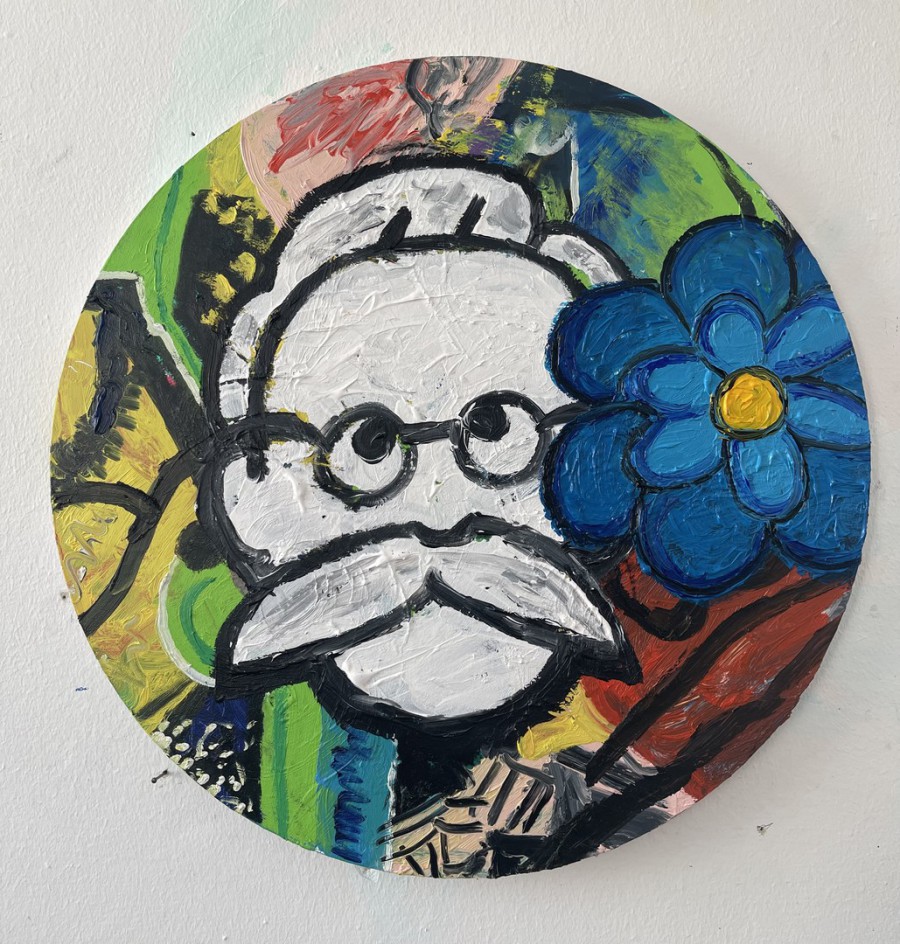
Nietzsche und die Blaue Blume, 2026, Arcyl/Öl/Leinwand, O 60 cm
Das Gemälde „Nietzsche und die blaue Blume“ inszeniert den Philosophen nicht als distanzierte Denkerfigur, sondern als Knotenpunkt eines geistigen Konflikts. In der kreisförmigen Bildfläche erscheint sein charakteristisches Gesicht – reduziert, fast ikonisch – in kräftigen schwarzen Linien und pastosem Weiß. Diese formale Vereinfachung kontrastiert mit dem expressiven, vielschichtigen Hintergrund aus leuchtenden Farben, der eher ein inneres als ein äußeres Terrain markiert: ein Raum von Spannungen, Übergängen und Umbrüchen.
Dominant tritt rechts die blaue Blume hervor, ein zentrales Symbol der Romantik. Sie steht traditionell für Sehnsucht, Transzendenz und die Suche nach einem verborgenen Sinn jenseits der Wirklichkeit. Im Gemälde jedoch ist sie nicht bloß poetisches Ornament, sondern eine aktive Kraft im Bildgeschehen. Sie drängt sich vor Nietzsches Gesicht, überschneidet seinen Blick und verschiebt den Fokus. Dadurch wird die Blume zu einem ambivalenten Zeichen: Sie ist sowohl Verlockung als auch Störung.
Diese Bildkonstellation spiegelt Nietzsches zwiespältiges Verhältnis zur Romantik. Einerseits ist er von ihrer Bildwelt, ihrer Kunstauffassung und ihrem Streben nach Tiefe geprägt – die blaue Blume gehört gewissermaßen zu seinem geistigen Erbe. Andererseits steht sie für genau jene Tendenzen, die er kritisch überwinden wollte: Weltflucht, Rausch, eine Fixierung auf Mangel und Verlust. Ihre Präsenz im Bild wirkt daher fast wie eine Prüfung oder ein Widerstand, dem sich die Figur Nietzsche gegenübersieht.
The painting “Nietzsche and the Blue Flower” portrays the philosopher not as a detached intellectual figure, but as the focal point of an intellectual conflict. His characteristic face appears within the circular picture plane—reduced, almost iconic—in bold black lines and impasto white. This formal simplification contrasts with the expressive, multi-layered background of vibrant colors, which marks an inner rather than an outer terrain: a space of tensions, transitions, and upheavals.
Dominantly, the blue flower emerges on the right, a central symbol of Romanticism. It traditionally stands for longing, transcendence, and the search for a hidden meaning beyond reality. In the painting, however, it is not merely a poetic ornament, but an active force in the pictorial narrative. It thrusts itself in front of Nietzsche’s face, obscures his gaze, and shifts the focus. This makes the flower an ambivalent sign: it is both a temptation and a disruption.
This pictorial constellation reflects Nietzsche’s ambivalent relationship to Romanticism. On the one hand, he is shaped by its imagery, its conception of art, and its quest for depth—the blue flower belongs, in a sense, to his intellectual legacy. On the other hand, it represents precisely those tendencies he sought to critically overcome: escapism, intoxication, a fixation on lack and loss. Its presence in the image therefore seems almost like a test or a resistance that the figure of Nietzsche faces.
 Druckversion