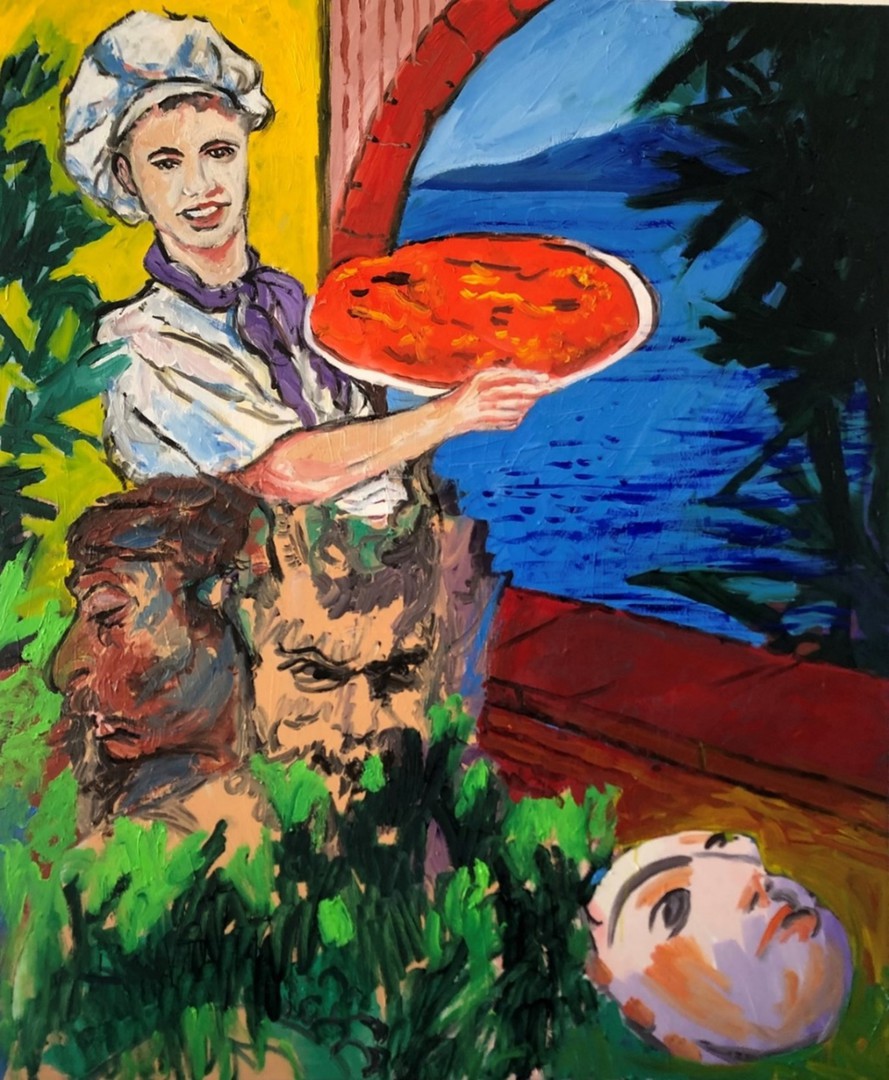
Der Pizzabäcker (Vesuvio), 2021, Öl/Leinwand, 120 x 100 cm
Unter dem Titel „Der Pizzabäcker (Vesuvio)“ verschiebt sich das Bild von einer topografisch-symbolischen Szene hin zu einer mythologisch aufgeladenen Rolleninszenierung. Die zentrale Figur - der junge Pizzabäcker - tritt als ordnende, kultivierende Instanz auf. Seine helle Kleidung und die Kopfbedeckung sowie das violette Halstuch verweist auf den selbstbewußten Bäcker - so als ob das Pizzabacken eine Art Geheimwissenschaft wäre. In seinen Händen hält er die Pizza wie eine flache, glutrote Scheibe, die zugleich Brot, Opfergabe und gezähmtes Feuer ist.
Die Pizza fungiert als Scharnier zwischen Natur und Kultur. Ihre Oberfläche erinnert unmissverständlich an Lava, an den Vesuv selbst im Hintergrund – doch die Pizza ist gebändigt, essbar, in eine runde, harmonische Form gezwungen. Der Pizzabäcker wird so fast zum Vulkan-Gott: Er verwandelt zerstörerische Energie in Nahrung, Hitze in Genuss.
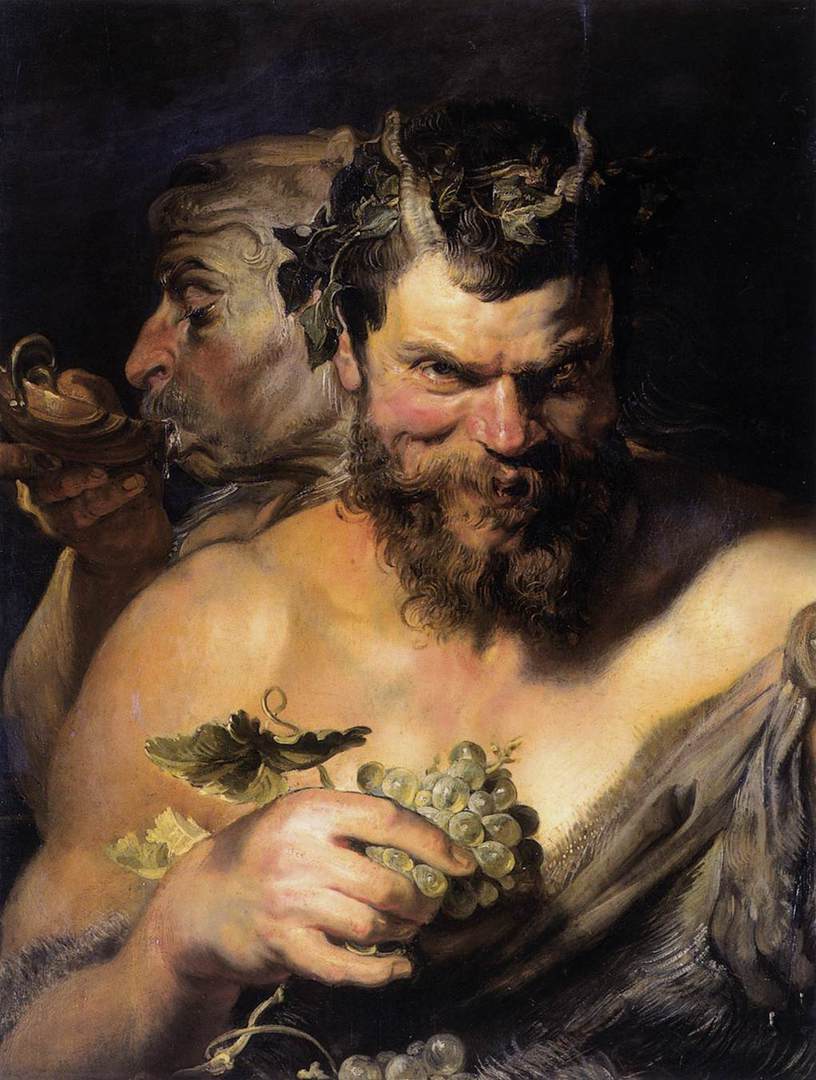 Peter Paul Rubens, Zwei Satyrn, 1618
Die Satyrn
Diese Lesart wird entscheidend vertieft durch meine malerischen Vor-Bilder der beiden mittleren Köpfe: Rubens’ „Zwei Satyrn“. Ihre Platzierung im unteren Bildzentrum, halb im Grün versunken, macht sie zu chthonischen Wesen: aus der Erde aufsteigend, triebhaft, ungebändigt. Ihre schweren, groben Gesichtszüge und die erdigen Farben kontrastieren scharf mit der Klarheit und Helligkeit der menschlichen Hauptfigur. Wie bei Rubens verkörpern sie das Dionysische – Lust, Naturtrieb, Maßlosigkeit –, hier jedoch fragmentiert, domestiziert, in die Vegetation zurückgedrängt.
Kultur - Natur
Der Pizzabäcker steht diesen Satyrn nicht frontal gegenüber, sondern über ihnen. Er hebt die Pizza auf Augenhöhe des Betrachters, nicht auf die der Satyrn. Damit entsteht eine subtile Hierarchie: Kultur wird gezeigt, Natur bleibt unten. Die Satyrn sind integriert – sie bilden den Untergrund, aus dem die Szene ihre Energie bezieht. Der Akt des Backens erscheint so als sublimierter Ritus: ein Ersatz für archaische Opfer, ein modernes Kultbild.
Der Hintergrund verstärkt diese Spannung. Der Vesuv liegt ruhig, fast gelassen am Horizont, das Meer ist glatt, das Blau kühl und stabil. Doch der rote Bogen – halb Architektur, halb Glutrahmen – erinnert daran, dass diese Ruhe prekär ist. Das Feuer ist nicht verschwunden, nur umgelagert: aus dem Berg in den Ofen, aus der Eruption in die Pizza.
Das zusätzliche, helle Maske rechts unten wirkt in dieser Lesart wie ein Gegenpol zu den Satyrn: eher staunend oder suchend. Sie könnte als menschlicher Betrachter im Bild gelesen werden – oder als Übergangsfigur zwischen Satyr und Zivilisation, zwischen Naturwesen und Kulturmensch.
Maltechnisch unterstützt die expressive, körperliche Pinselführung diese Deutung. Die Farbe ist nicht glatt, sondern aufgewühlt; sie trägt Spuren von Bewegung und Widerstand. Das Bild „arbeitet“ sichtbar – wie Teig, wie Lava. Ordnung entsteht nicht durch Glätte, sondern durch Formgebung im Chaos.
„Der Pizzabäcker“ erscheint so als zeitgenössische Allegorie: eine Synthese aus Mythos, Alltagskultur und Kunstgeschichte. Rubens’ Satyrn werden aus dem barocken Überfluss in eine moderne, mediterrane Szene versetzt; der Vesuv wird vom Schicksalsberg zur Kochstelle der Kultur.
The Pizza Maker (Vesuvio), 2021, oil on canvas, 120 x 100 cm
Under the title “The Pizza Baker (Vesuvio),” the image shifts from a topographically symbolic scene to a mythologically charged role-play. The central figure—the young pizza baker—appears as an organizing, cultivating authority. His light-colored clothing, headwear, and purple neckerchief point to the self-assured baker—as if pizza-making were a kind of secret science. In his hands, he holds the pizza like a flat, glowing-red disc that is at once bread, an offering, and tamed fire.
The pizza functions as a hinge between nature and culture. Its surface unmistakably evokes lava, Vesuvius itself in the background—yet the pizza is tamed, edible, forced into a round, harmonious shape. The pizza maker thus becomes almost a volcano god: he transforms destructive energy into food, heat into pleasure.
The Satyrs
This interpretation is significantly deepened by my painterly models for the two central heads: Rubens’ “Two Satyrs.” Their placement in the lower center of the picture, half-submerged in greenery, makes them chthonic beings: rising from the earth, instinctual, untamed. Their heavy, coarse features and earthy colors contrast sharply with the clarity and brightness of the human protagonist. As in Rubens, they embody the Dionysian—lust, natural instinct, excess—but here they are fragmented, domesticated, pushed back into the vegetation.
Culture - Nature
The pizza maker does not stand directly opposite these satyrs, but above them. He raises the pizza to the viewer’s eye level, not to that of the satyrs. This creates a subtle hierarchy: culture is displayed, nature remains below. The satyrs are integrated—they form the ground from which the scene draws its energy. The act of baking thus appears as a sublimated rite: a substitute for archaic sacrifices, a modern cult image.
The background reinforces this tension. Vesuvius lies calm, almost serene, on the horizon; the sea is smooth, the blue cool and stable. Yet the red arch—half architecture, half frame of embers—serves as a reminder that this calm is precarious. The fire has not disappeared, only shifted: from the mountain to the oven, from the eruption to the pizza.
In this interpretation, the additional, bright mask in the lower right appears as a counterpoint to the satyrs: more in wonder or searching. It could be read as a human observer in the picture—or as a transitional figure between satyr and civilization, between natural being and cultured human.
In terms of painting technique, the expressive, physical brushwork supports this interpretation. The paint is not smooth, but churned up; it bears traces of movement and resistance. The painting visibly “works”—like dough, like lava. Order arises not through smoothness, but through shaping within chaos.
“The Pizza Maker” thus appears as a contemporary allegory: a synthesis of myth, everyday culture, and art history. Rubens’ satyrs are transposed from Baroque opulence into a modern, Mediterranean scene; Vesuvius is transformed from a mountain of fate into the cooking site of culture.
 Druckversion