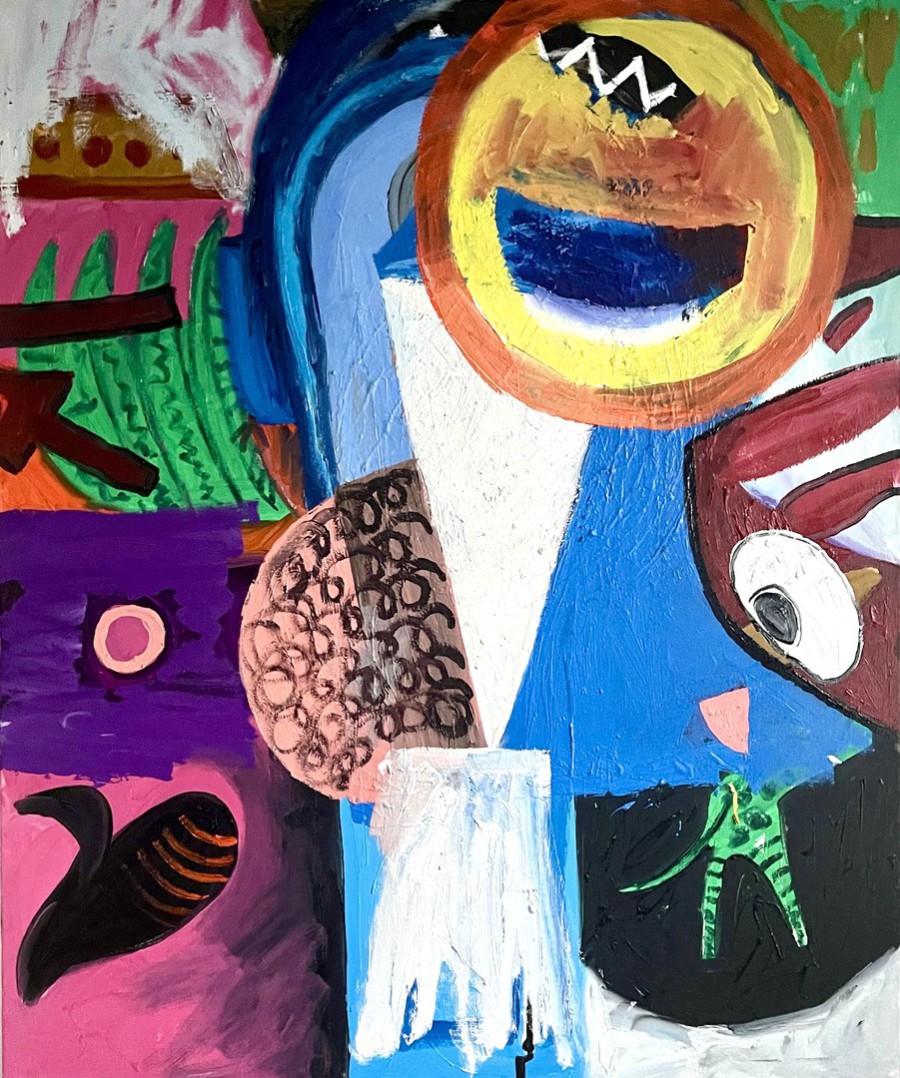
Kosmos im Clownskostüm, 2025, Öl/Leinwand, 120 x 100 cm
„Der Gesammt-Charakter der Welt ist dagegen in alle Ewigkeit Chaos.“
– Friedrich Nietzsche
Das Gemälde „Kosmos im Clownskostüm“ wirkt wie ein Schlag gegen den Versuch, Ordnung zu erkennen. In einem Geflecht aus Farben, Formen und Symbolen konfrontiert es die Betrachter mit einem visuellen Universum, das sich jeder linearen Deutung entzieht. Statt einer klaren Komposition offenbart sich ein bewusst gesetztes Chaos, das – so paradox es scheint – seine eigene Form von Struktur besitzt. Wie ein Clown, der hinter seinem grellen Kostüm eine tiefere Wahrheit verbirgt, spielt das Bild mit den Gegensätzen von Heiterkeit und Bedrohung, Ordnung und Chaos.
Maske des Universums
Im Zentrum sticht ein gelber Kreis mit grinsender Fratze hervor, von einem orangefarbenen Rand umgeben, der beinahe wie eine Sonne wirkt – jedoch ohne Licht, dafür mit Zähnen. Dieses Gesicht ist eine Art Spottgebärde, ein kosmisches Lachen. Die Farbwelt ist schrill, dissonant, beinahe provokativ gewählt: giftiges Grün, überzeichnetes Magenta, hartes Schwarz, kaltes Blau in einer Art Gleichzeitigkeit der Gegensätze. Alles scheint gleich wichtig – oder gleich bedeutungslos.
Clown
Im Titel des Bildes – „Kosmos im Clownskostüm“ – liegt bereits der gedankliche Sprengstoff. Der Kosmos, traditionell als Inbegriff göttlicher oder rationaler Ordnung verstanden, wird hier verniedlicht. Der Clown, als Sinnbild der Ironie und Verkehrung, wird zum Träger des Universums. Oder umgekehrt: Das Universum ist selbst der Clown, dessen Darbietung wir nicht durchschauen. Was zunächst wie ein harmloser Scherz wirkt, entpuppt sich als tiefer Ernst – und umgekehrt. Die zentrale Figur des Bildes, zusammengesetzt aus geometrischen Flächen und organischen Strukturen, trägt nicht zufällig ein Gesicht, das zugleich menschlich und monströs erscheint. Sie ist Personifikation und Parodie zugleich.
Kosmos als Person
Hier berührt das Werk eine Tradition, die bis in die Antike zurückreicht. In Platons Timaios erscheint der Kosmos selbst als lebendiges Wesen, ausgestattet mit Seele und Geist, als eine Art Weltperson, deren Harmonie Maßstab für Wahrheit und Ordnung ist. Diese Vorstellung eines belebten Universums wirkte weit über die Antike hinaus, durch Mittelalter und frühe Neuzeit, bis hinein in astrologische WeltBilder, in denen der Mensch sich als Teil eines kosmischen Körpers verstand.
Das Gemälde greift diese anthropomorphe Kosmosidee auf – jedoch nicht affirmativ, sondern in radikaler Brechung. Der Kosmos erscheint hier nicht als vollkommener Weltmensch, sondern als clowneske, groteske Figur. Die göttliche Harmonie ist zur Grimasse geworden. Der ehemals erhabene Weltkörper lacht uns an, aber dieses Lachen ist zweideutig: verspielt und bedrohlich zugleich.
Fragment und Vieldeutigkeit
In den ornamentalen Mustern, den pflanzlichen Motiven, den tierähnlichen Andeutungen scheint eine Fülle kultureller, vielleicht archetypischer Bezüge auf. Aber nichts wird erklärt, nichts eindeutig benennbar gemacht. Die Formen bleiben vage, fragmentarisch, wie Versatzstücke aus einem kollektiven Bildgedächtnis. Was bleibt, ist ein permanentes Spiel zwischen Interpretation und Irritation. Der Versuch, eine Bedeutung zu fixieren, scheitert an der Offenheit des Bildes – oder an dessen Weigerung, sich deuten zu lassen.
Zusammenfall der Gegensätze
Gerade darin liegt die Kraft dieses Werks: Es führt den Betrachter nicht zur Erkenntnis, sondern in die Erkenntnisverweigerung. Es feiert die Vieldeutigkeit, das Widersprüchliche, das Absurde – und entlarvt damit die menschliche Sehnsucht nach Klarheit als naives Bedürfnis. Der Kosmos erscheint nicht als Maschine, sondern als paradoxe Einheit aus Ordnung und Anarchie.
In dieser Gleichzeitigkeit schimmert die Idee des Zusammenfalls der Gegensätze auf, wie sie Nikolaus von Kues formulierte. Wahrheit liegt hier nicht in der Trennung, sondern im Paradox: im Gleichzeitigen von Ernst und Lächerlichkeit, Schönheit und Groteske, Kosmos und Chaos. Das Bild scheint diese Denkfigur nicht zu illustrieren, sondern visuell zu vollziehen.
Chaos
Aus meiner Perspektive des Künstlers ist dieses Chaos kein theoretisches Konzept, sondern ein Zustand. Der Schöpfungsakt ist keine disziplinierte Konstruktion, sondern eine Explosion. Nietzsches Satz, man müsse noch Chaos in sich haben, um einen tanzenden Stern gebären zu können, beschreibt diesen Prozess präzise. Das Bild ist ein solcher Stern: instabil, überdreht, lebendig.
Der Rückgriff auf vormoderne Topoi bedeutet dabei keine Abkehr von Aufklärung oder Wissenschaft. Diese Denkfiguren werden nicht als Wahrheiten reaktiviert, sondern als kulturelles Material verwendet. Sie fungieren als Masken, Metaphern, Spielräume. Ihre Kraft liegt nicht in empirischer Geltung, sondern in symbolischer Dichte. Gerade die ironische, clowneske Brechung verhindert jede dogmatische Lesart und macht deutlich, dass hier kein WeltBild restauriert, sondern ein Bildraum geöffnet wird.
Lachen
So wird das Lachen im Bild – dieses breite, fast gewaltsame Grinsen – zum eigentlichen Zentrum: nicht nur visuell, sondern existenziell. Es ist das Lachen des Clowns, das aus dem Abgrund kommt. Oder das Lachen des Universums über jene, die es begreifen wollen. Ein Lachen, das bleibt, wenn alle Sicherheiten ins Rutschen geraten.
„Kosmos im Clownskostüm“ zeigt das Chaos nicht als Defizit, sondern als Essenz. Und es behauptet, dass gerade dort, wo Gegensätze kollabieren, wo alte Bilder tanzen und neue Bedeutungen entgleiten, etwas entsteht, das lebendig ist: ein Stern, der tanzt.
Cosmos in a Clown's Costume, 2025, oil on canvas, 120 x 100 cm
“The overall character of the world, on the other hand, is chaos for all eternity.”
– Friedrich Nietzsche
The painting “Cosmos in a Clown Costume” feels like a blow to any attempt to discern order. In a web of colors, shapes, and symbols, it confronts the viewer with a visual universe that eludes any linear interpretation. Instead of a clear composition, a deliberately created chaos reveals itself, which—as paradoxical as it may seem—possesses its own form of structure. Like a clown who hides a deeper truth behind his garish costume, the image plays with the contrasts of cheerfulness and menace, order and chaos.
Mask of the Universe
In the center, a yellow circle with a grinning face stands out, surrounded by an orange border that almost resembles a sun—yet without light, but with teeth. This face is a kind of mocking gesture, a cosmic laugh. The color palette is garish, dissonant, almost provocatively chosen: toxic green, exaggerated magenta, harsh black, cold blue in a sort of simultaneity of opposites. Everything seems equally important—or equally meaningless.
Clown
The title of the image—“Cosmos in a Clown Costume”—already contains the intellectual dynamite. The cosmos, traditionally understood as the epitome of divine or rational order, is trivialized here. The clown, as a symbol of irony and inversion, becomes the bearer of the universe. Or conversely: the universe itself is the clown whose performance we cannot fathom. What at first appears to be a harmless joke turns out to be profound seriousness—and vice versa. The central figure of the image, composed of geometric planes and organic structures, does not by chance bear a face that appears both human and monstrous. It is both personification and parody.
The Cosmos as a Person
Here, the work touches upon a tradition that stretches back to antiquity. In Plato’s Timaeus, the cosmos itself appears as a living being, endowed with soul and spirit, as a kind of world-person whose harmony serves as the standard for truth and order. This conception of an animated universe had an impact far beyond antiquity, through the Middle Ages and early modern times, into astrological worldviews in which humans understood themselves as part of a cosmic body.
The painting takes up this anthropomorphic idea of the cosmos—not affirmatively, however, but in a radical subversion. Here, the cosmos appears not as a perfect world-man, but as a clownish, grotesque figure. Divine harmony has become a grimace. The once-sublime world-body smiles at us, but this smile is ambiguous: playful and threatening at the same time.
Fragment and Ambiguity
In the ornamental patterns, the botanical motifs, the animal-like allusions, a wealth of cultural, perhaps archetypal references emerges. But nothing is explained, nothing made unambiguously identifiable. The forms remain vague, fragmentary, like set pieces from a collective visual memory.
What remains is a constant interplay between interpretation and confusion. The attempt to pin down a meaning fails due to the image’s openness—or its refusal to be interpreted.
The Convergence of Opposites
This is precisely where the power of this work lies: it does not lead the viewer to insight, but rather to a refusal of insight. It celebrates ambiguity, contradiction, the absurd—and thereby exposes the human longing for clarity as a naive need. The cosmos appears not as a machine, but as a paradoxical unity of order and anarchy.
In this simultaneity, the idea of the convergence of opposites, as formulated by Nikolaus von Kues, glimmers through. Truth lies here not in separation, but in the paradox: in the simultaneity of seriousness and absurdity, beauty and the grotesque, cosmos and chaos. The image seems not to illustrate this figure of thought, but to visually enact it.
Chaos
From my perspective as an artist, this chaos is not a theoretical concept, but a state. The act of creation is not a disciplined construction, but an explosion. Nietzsche’s statement that one must still have chaos within oneself to be able to give birth to a dancing star describes this process precisely. The image is such a star: unstable, overexcited, alive.
The recourse to pre-modern topoi does not imply a turning away from the Enlightenment or science. These figures of thought are not reactivated as truths, but used as cultural material. They function as masks, metaphors, spaces for play. Their power lies not in empirical validity, but in symbolic density. It is precisely the ironic, clownish subversion that prevents any dogmatic interpretation and makes it clear that no worldview is being restored here, but rather a pictorial space is being opened.
Laughter
Thus, the laughter in the image—this broad, almost violent grin—becomes the true center: not only visually, but existentially. It is the clown’s laughter that comes from the abyss. Or the universe’s laughter at those who wish to comprehend it. A laughter that remains when all certainties begin to slip away.
“Cosmos in a Clown’s Costume” presents chaos not as a deficit, but as an essence. And it asserts that precisely where opposites collapse, where old images dance and new meanings slip away, something comes into being that is alive: a star that dances.
 Druckversion